


Commercial Flagpole Wind Ratings: What Project Managers Must Verify
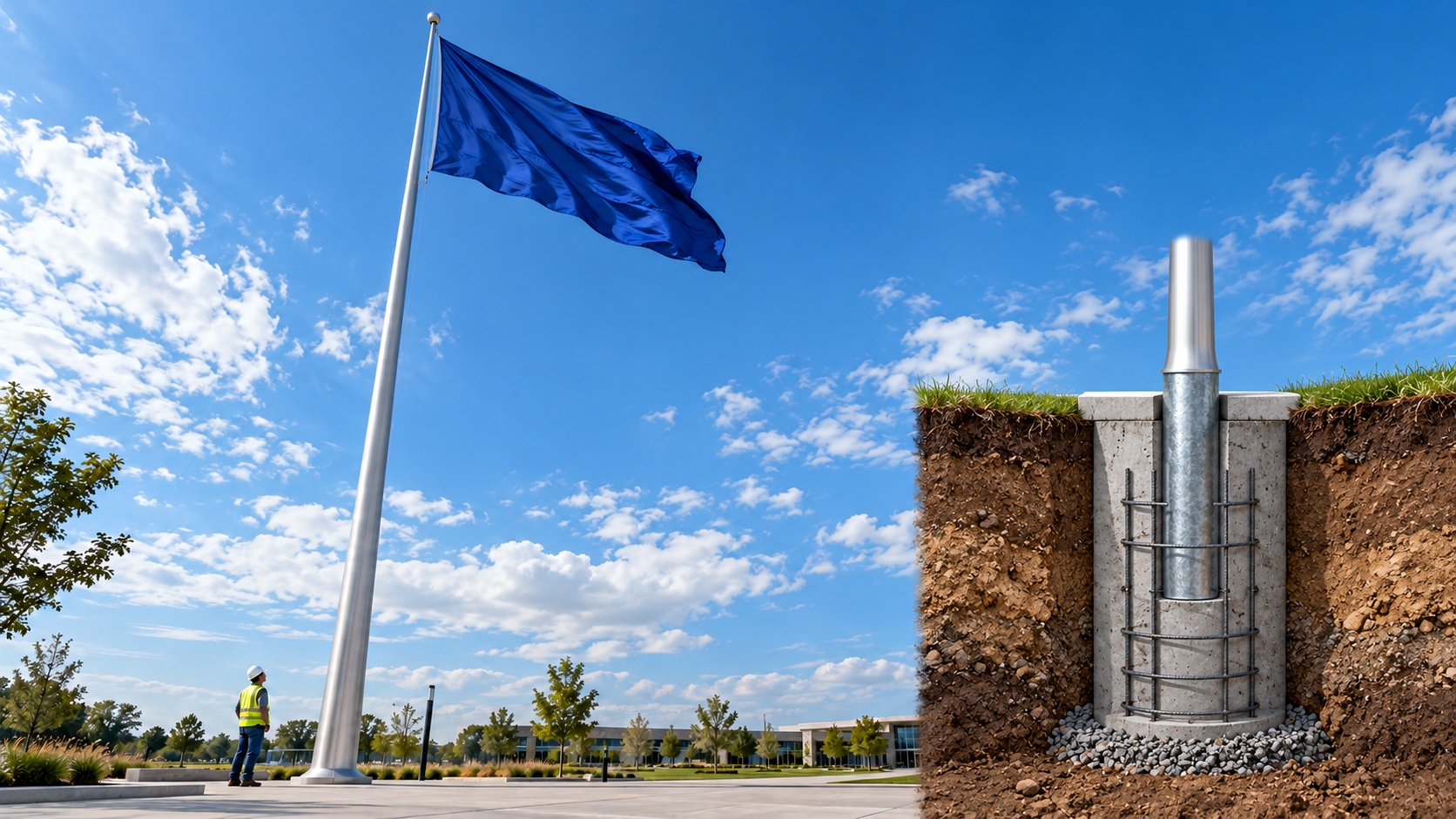
A commercial flagpole should never be selected using height and price alone.
Before approving a flagpole, project managers must verify six factors: the project location and local design wind speed, exposed flagpole height, flag size and number of flags, the flagged wind rating, foundation and anchoring requirements, and responsibility for engineering approval.
The most common specification mistake is accepting a high wind-speed rating without checking whether it applies when the required flag is flying. A flagpole rated for 170 mph without a flag may have a much lower rating with an 8 × 12-foot flag attached.
Information Required Before Selecting a Flagpole
Provide the following information when requesting a commercial flagpole quotation:
| Required information | Why it matters | Usually provided by |
|---|---|---|
| Project city, state or postal code | Determines applicable wind and environmental conditions | Owner or contractor |
| Exposed pole height | Affects bending moment and foundation load | Architect or owner |
| Flag dimensions and quantity | Determines the actual wind load | Owner or architect |
| Site exposure | Open coastal sites differ from sheltered urban sites | Engineer or contractor |
| Soil and groundwater information | Required for final foundation design | Geotechnical or civil engineer |
| Required design code | Establishes engineering criteria | Project engineer |
Without this information, a supplier can provide only a preliminary recommendation—not a final project-specific selection.
Flagged vs. Unflagged Wind Rating
Unflagged wind rating
The unflagged rating applies when no flag is attached. Because the bare pole presents a relatively small area to the wind, this number can appear very high. It should not be used by itself to approve a flagpole that will normally fly a flag.
Flagged wind rating
The flagged wind rating applies when a specified flag—or specified combination of flags—is attached. A usable flagged rating should identify the flag dimensions, number of flags, applicable design standard, wind-speed basis, pole configuration and operating limitations.
If a supplier states only that a flagpole is “hurricane rated” or “suitable for high winds,” ask for the numerical flagged rating and its design assumptions.
A Typical Project Example
Consider a project requiring one 40-foot commercial flagpole, one 8 × 12-foot flag, an internal halyard, and installation in a region with a 115 mph project design wind speed.
A supplier offers a flagpole with a published unflagged rating of 171 mph. That figure alone does not prove the pole is suitable.
The project manager should request confirmation of the pole’s rating with an 8 × 12-foot flag, the wind standard used, base shear and overturning moment, required foundation or anchoring system, and whether project-specific engineering approval is available.
If the same pole is rated for only 110 mph with the required flag, it may not satisfy the project criteria even though its unflagged rating is 171 mph. The project engineer must make the final determination under the applicable code and design conditions.
Why Flag Size Changes the Result
A flag is not a minor accessory. Increasing its size can increase wind force, bending stress, base shear, foundation overturning moment, movement, vibration and wear on the halyard and fittings. Flying two flags also creates a different load from flying one.
Specify the flag dimensions and quantity before selecting the pole. Adding a larger flag after installation may invalidate the assumptions used in the original structural recommendation.
The Foundation Is Part of the Structural System
A strong flagpole installed on an inadequate foundation is not a safe installation. Foundation dimensions may depend on pole reactions, local wind criteria, soil strength, frost depth, groundwater, foundation type, concrete strength, reinforcement and local building requirements.
A standard manufacturer foundation detail may assist preliminary budgeting, but it can be based on assumed soil and wind conditions that do not match the project site. The team should establish whether a drawing is a general recommendation, a design based on stated assumptions, or a project-specific engineered foundation.
Ground-Set and Base-Plate Foundations
Ground-set flagpole
A ground-set flagpole is installed inside a sleeve embedded in a concrete foundation. The supplier should provide sleeve dimensions, minimum embedment, centering method, drainage details, sealing instructions and the pole removal procedure.
Base-plate flagpole
A base-plate flagpole is secured to anchor rods cast into concrete. The supplier should provide base-plate dimensions, anchor-bolt diameter, bolt-circle dimensions, anchor template, required embedment, base reactions, leveling instructions and installation tolerances.
The anchor template must be checked before concrete is poured. Incorrect bolt placement is one of the most expensive and avoidable installation errors.
Who Is Responsible for Engineering?
Engineering responsibility must be stated in the quotation and contract. The manufacturer may be responsible for pole design, flagged wind-rating data and base reactions. A project structural or civil engineer may be responsible for the site-specific foundation, while a geotechnical consultant supplies soil parameters.
Do not assume a standard manufacturer drawing is signed and sealed for the project location. If stamped engineering is required, confirm who provides it, which jurisdiction it covers, what information is needed, how much it costs and how long it takes.
Six Warning Signs in a Flagpole Quotation
- Only one wind-speed number is provided. The quotation does not identify whether it is flagged or unflagged.
- The flag size is missing. A flagged rating has limited value without the corresponding flag dimensions and quantity.
- The product is only described as “hurricane rated.” This is not a complete engineering specification.
- No foundation reactions are available. The project engineer may be unable to verify the foundation.
- A generic foundation drawing is presented as universally suitable. Wind, soil, frost and groundwater conditions vary.
- Engineering responsibility is unclear. The supplier, installer and project engineer may each assume another party owns final approval.
Technical Documents to Request
- Product data sheet and shop drawings
- Exposed and overall pole height
- Butt diameter, top diameter and wall thickness
- Material and finish specifications
- Flagged and unflagged wind ratings
- Approved flag size and quantity
- Pole base reactions
- Foundation or anchor details
- Installation and maintenance instructions
- Warranty and replacement-parts information
- Production lead time, shipping dimensions and weight
Where required, request structural calculations and drawings signed by an engineer licensed in the project jurisdiction.
Questions to Send to Every Supplier
- What is the unflagged wind-speed rating?
- What is the rating with our specified flag size and quantity?
- Which design standard and wind-speed basis were used?
- Can you provide base shear and overturning reactions?
- What foundation or anchoring system is recommended?
- Is the foundation detail generic or project-specific?
- Can you provide signed and sealed engineering if required?
- What information do you need from our project engineer?
- What items are excluded from your quotation?
- What is the lead time after drawing approval?
- What are the shipping dimensions and unloading requirements?
- What warranty and replacement parts are available?
Frequently Asked Questions
What is the difference between flagged and unflagged wind ratings?
The unflagged rating applies to the bare pole. The flagged rating applies when a specified flag or combination of flags is attached. For an operating flagpole, the flagged rating is normally more relevant.
Does a commercial flagpole require an engineered foundation?
Many commercial, municipal, educational and high-wind projects require engineering review. Requirements depend on local regulations, pole height, wind, soil and the project specification.
Can the manufacturer design the foundation?
Some manufacturers provide only standard details and base reactions. Others offer project-specific calculations. Confirm whether the documents are suitable for permitting and can be signed by an engineer licensed in the project jurisdiction.
Can a larger flag be installed later?
Only after verifying that the pole, fittings, anchoring and foundation can support the increased load. A larger flag may reduce the safe flagged wind-speed rating.
Final Procurement Checklist
Before approval, confirm that the design wind criteria are known, the flag size and quantity are fixed, both wind ratings are documented, base reactions are available, foundation responsibility is assigned, the complete installation scope is defined, and warranty support is documented.
If any of these items is missing, the flagpole selection is not ready for final approval.
Need a Preliminary Flagpole Selection?
Send us your project location, required exposed height, flag size and quantity, preferred material and finish, halyard preference and required installation date.
Our team can provide a preliminary pole recommendation, flagged wind-rating review, engineering-data checklist and itemized quotation.
Final product selection and foundation design remain subject to project specifications, local codes and approval by the responsible licensed engineer.