


Sustainable Flagpole Specification: Recycled Metals, EPD & LEED Review
Sustainable Flagpole Specification: Recycled Metals, EPD & LEED Review
Short answer: A sustainable commercial flagpole specification should identify the metal source, recycled-content evidence, finish documentation, life-cycle boundaries, packaging, maintenance assumptions, and end-of-life route. These documents may support a LEED review, but they do not automatically create project credits.
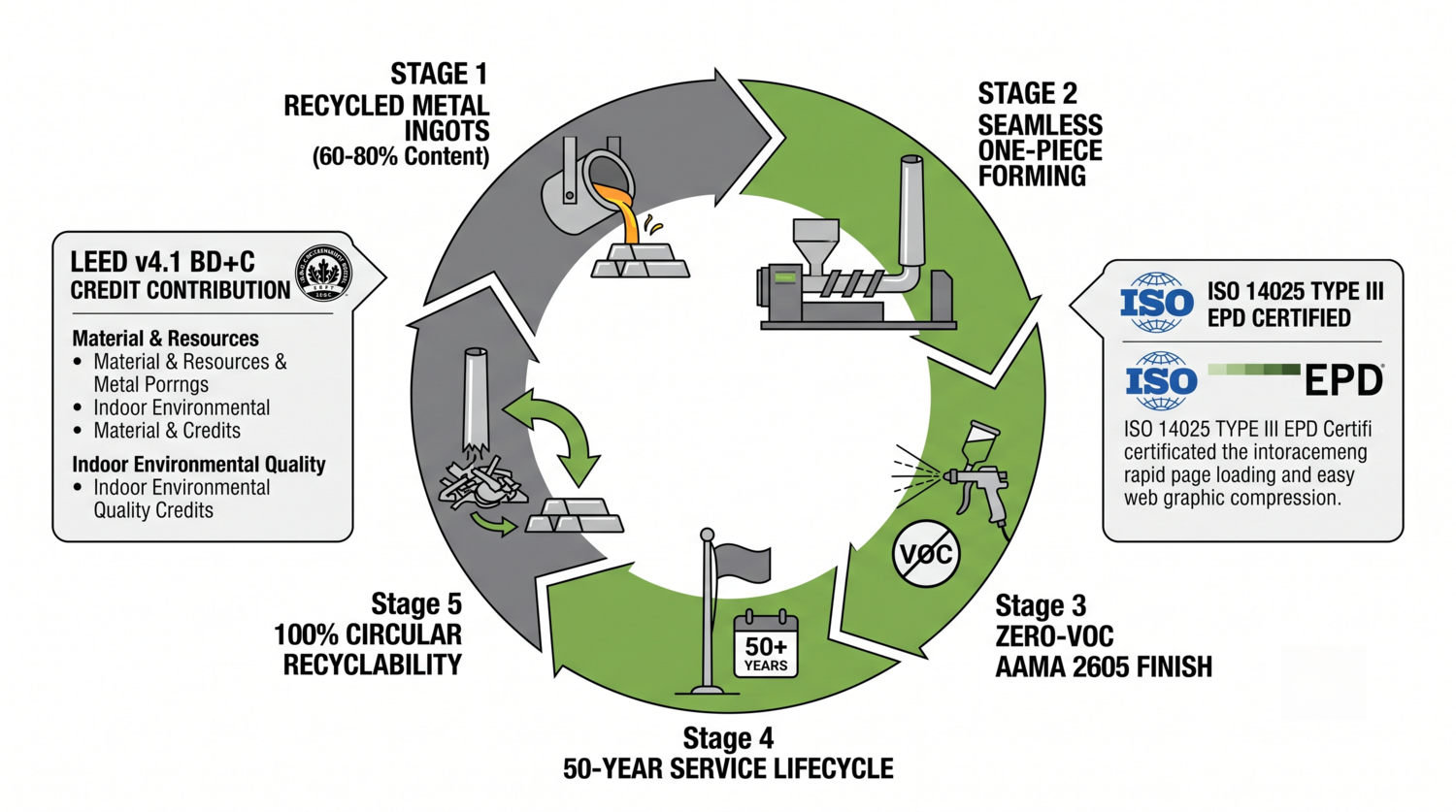
What Should Be Verified First?
Before a commercial flagpole is included in a green-building submittal, confirm the exact product configuration. The required evidence may change with the shaft material, coating system, hardware, foundation interface, project location and certification pathway.
- Material grade, alloy or stainless-steel specification.
- Pre-consumer and post-consumer recycled-content percentages.
- Supplier declarations, mill certificates and chain-of-custody evidence.
- Finish type, coating performance data and applicable emissions documentation.
- Product-specific EPD or a clearly identified industry-average EPD.
- Transport packaging, maintenance requirements and end-of-life handling.
How Flagpoles May Support LEED Review
LEED v4.1 Building Design and Construction includes material disclosure and optimization categories. A flagpole may be considered as part of the project material documentation, but the design team must confirm whether the product is included in the project calculation and whether the submitted evidence satisfies the current credit requirements.
Do not describe a flagpole as automatically “LEED certified.” LEED certification applies to the building or project rating process. A supplier can provide documents that support the review, such as an EPD, recycled-content declaration or product-composition information.
Recycled Metal Evidence
Recycled content should be reported by material and by calculation method. Pre-consumer content normally refers to manufacturing scrap diverted from the waste stream. Post-consumer content comes from products that have completed their use phase and are returned for recycling.
For procurement, request the percentage, material basis, reporting period and supporting records. A general statement such as “made with recycled metal” is not enough for a project calculation. The project consultant should also confirm whether the selected credit accepts the stated evidence.
EPD and LCA Documentation
An Environmental Product Declaration describes environmental impacts using a defined life-cycle assessment method. ISO 14025 addresses Type III environmental declarations, while ISO 14040 and ISO 14044 provide principles and requirements for life-cycle assessment.
When reviewing an EPD, check the following:
- Product name, manufacturer and declared unit.
- Program operator, verification method and validity period.
- Life-cycle modules included, such as A1-A3, A4, B and C.
- Manufacturing sites, material sources and key assumptions.
- Whether the document is product-specific or industry-average.
- Whether the EPD covers the actual shaft, finish and accessories being purchased.
Finishes and Manufacturing Process
Factory-applied finishes can help control application consistency and reduce field work, but the finish specification still needs to be reviewed. AAMA 2605 or another coating performance reference does not, by itself, prove that a product earns a LEED credit or has zero site emissions.
For aluminum or stainless-steel flagpoles, ask for the finish system, test basis, color, surface preparation, repair procedure and expected maintenance environment. If a powder, PVDF or anodized finish is proposed, request the applicable technical data and environmental documentation for the exact system.
Manufacturing efficiency should also be described carefully. Continuous forming, controlled welding and factory inspection may reduce assembly work and packaging complexity, but the environmental benefit depends on actual material use, energy sources, scrap recovery and transport distance.
End-of-Life and Procurement Matrix
| Topic | Evidence to Request | Review Point |
|---|---|---|
| Recycled metal | Material declaration and supporting records | Confirm calculation basis and applicability |
| EPD | Valid product-specific or generic EPD | Check scope, modules, verifier and validity |
| Coating | Finish specification and technical data | Confirm performance and emissions evidence |
| End of life | Disassembly and recycling guidance | Separate metal, coating and accessories where practical |
Questions for the Flagpole Supplier
- Which documents apply to the exact model and material being quoted?
- Is the recycled-content percentage certified, declared or estimated?
- Does the EPD cover the complete product or only the shaft material?
- Which coating standard and test data apply to the selected finish?
- What maintenance interval should be used in the project LCA?
- How should the product be dismantled and recycled at the end of service?
Frequently Asked Questions
Does specifying a recycled-metal flagpole automatically earn LEED points?
No. Recycled content may support a material credit calculation, but the project team must verify the current rating-system requirements, calculation method and supporting evidence.
Is an EPD the same as a product certification?
No. An EPD is a standardized environmental declaration based on defined life-cycle information. It should be reviewed for scope, verification, validity and product coverage.
Does AAMA 2605 mean that a coating is zero VOC?
Not automatically. AAMA 2605 describes coating performance requirements. VOC and project-credit conclusions require separate technical and environmental documentation.
References
- USGBC LEED v4.1
- ISO 14025 Environmental Labels and Declarations
- ISO 14040 Life Cycle Assessment Principles and Framework
- ISO 14044 Life Cycle Assessment Requirements and Guidelines
Fortune Pole can discuss commercial flagpole materials, finishes and project documentation requirements. Product-specific environmental claims should be confirmed against the final quotation, technical submittal and available verification documents.