


School Campus Flagpole Safety Guide
School Campus Flagpole Safety Guide
Flagpoles installed at schools, universities and other institutional properties should be evaluated as part of the site safety plan. Accessible ropes, exposed cleats, service doors, connection details, surrounding furniture and maintenance procedures can all affect the risk profile.
1. Begin With a Site Safety Review
Before selecting the flagpole, review the installation zone, pedestrian routes, playgrounds, sports areas, gathering points, lighting, surveillance, landscaping and access for maintenance personnel.
Document the flagpole height, flag size, design wind speed, foundation, nearby structures and any local school or public-facility safety requirements. A flagpole supplier can provide hardware information, but the owner, designer and responsible safety professionals must determine the appropriate site controls.
2. Reduce Access to Loose Rigging
External ropes and open cleats can be pulled, untied or manipulated by unauthorized users. They can also create loops or protruding components that require additional risk review in areas used by children and students.
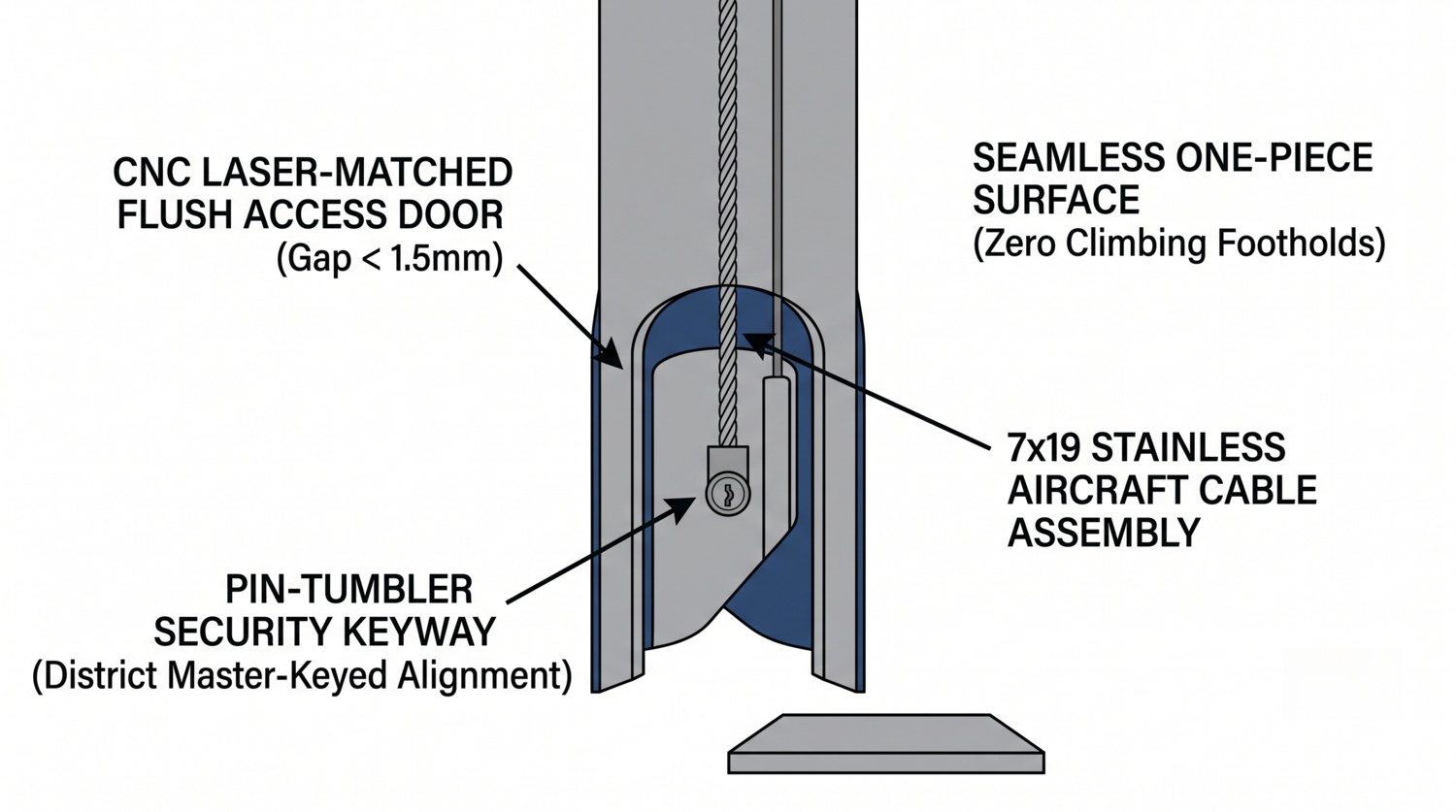
An internal halyard or internal winch can place the operating cable inside a lockable shaft compartment. This can reduce routine access to the rigging, but the complete system still requires review of the hatch, cable path, drainage, locking method, emergency lowering procedure and maintenance access.
Where wire rope is selected, confirm the cable construction, breaking strength, end fittings, corrosion resistance and compatibility with the winch. The equipment manufacturer should define the inspection and replacement interval.
3. Use Low-Profile, Lockable Access Hardware
A campus flagpole may use a flush or low-profile access door with a lock selected for the operating environment. The door should be designed to limit unauthorized access while still allowing trained maintenance personnel to inspect and service the equipment.
Specify the lock type, key management, door material, hinges, fasteners, gasket, drainage and corrosion protection. Avoid promising a universal child-proof or tamper-proof result. The performance depends on the selected hardware, installation quality, surrounding access and the campus maintenance policy.
4. Review Climbing Opportunities Without Absolute Claims
Flagpole safety reviews should consider accessible cleats, handles, brackets, exposed ropes, joint shoulders, base covers, nearby benches and other objects that could assist climbing. A smooth shaft and concealed operating hardware may reduce some accessible footholds, but they do not guarantee that climbing is impossible.
Where a sectional flagpole is required for transportation or lifting, the joints should be located, detailed and inspected according to the design. The project team should also review nearby landscaping and furniture so that the complete installation does not create an unintended access path.
5. Structural Design and Foundation
The flagpole must be designed for the actual height, flag area, wind exposure, accessories, soil conditions and foundation. NAAMM FP 1001 provides guidance related to flagpole wind pressure, flag loading, bending moments, shear, torsion and stress analysis.
For projects using North American loading criteria, ASCE/SEI 7-22 may be relevant. The applicable local code and engineer-approved design criteria remain controlling.
6. Consider Noise and Daily Operations
Flagpoles near classrooms, dormitories, libraries or offices may transmit noise through moving cables, counterweights, access doors or loose components during wind. The project can specify cable guides, protective sleeves, isolated counterweights or other noise-control details where appropriate.
Maintenance staff should have a documented procedure for flag changes, emergency lowering, lubrication, cable inspection, lock management and reporting of damage. A secure design must remain serviceable for the people responsible for the site.
7. Institutional Safety Specification Matrix
| Safety factor | Specification focus | Evidence to request |
|---|---|---|
| Rigging access | Internal halyard or controlled external arrangement | Operating and maintenance procedure |
| Access door | Low-profile lockable door with drainage | Hardware data and key-control plan |
| Climbing risk | Review of cleats, brackets, joints and nearby objects | Site safety assessment |
| Structure | Wind, flag area, foundation and attachments | Engineer-approved calculations |
| Maintenance | Inspection, emergency lowering and replacement | Service schedule and spare parts |
8. Procurement Checklist
- Identify pedestrian, student and maintenance access around the site.
- Review external ropes, cleats, brackets, doors and other accessible components.
- Specify the lock, key management and authorized-access procedure.
- Confirm the halyard, winch, cable and emergency-lowering arrangement.
- Check flagpole height, flag area, wind criteria and foundation design.
- Review nearby furniture, landscaping, lighting and surveillance.
- Define inspection, lubrication, cable replacement and damage-reporting procedures.
- Obtain installation drawings and maintenance documentation.
Frequently Asked Questions
Can a flagpole be guaranteed to be child-proof?
No. A supplier can reduce access to rigging and exposed hardware, but the final risk depends on the complete site, supervision, maintenance and local safety requirements.
Are internal winches safer for school campuses?
They can reduce access to ropes and operating components when properly enclosed and maintained. The hatch, locking system, cable path, emergency procedure and service access must still be evaluated.
Does a seamless one-piece shaft prevent climbing?
No. A smooth shaft may reduce some accessible joints or ledges, but it does not make climbing impossible. The surrounding site must also be reviewed.
How should school districts manage multiple flagpoles?
Use a documented asset register, controlled keys, standard inspection forms, scheduled cable checks and a clear procedure for routine and emergency lowering.
References
- NAAMM FP 1001: Guide Specifications for Design of Metal Flagpoles
- ASCE/SEI 7-22: Minimum Design Loads
- ASTM standards and technical information
- Fortune Pole commercial flagpole solutions
For a school or campus quotation, provide the location, flagpole height, flag dimensions, wind criteria, surrounding site use, preferred operating system, lock requirements, foundation conditions and maintenance plan.