


Quiet Flagpole Design: Cable Slap & Damping
Quiet Flagpole Design: Cable Slap & Damping
Short answer: Quiet flagpole design starts by identifying the moving parts that can strike the shaft, the vibration path through the base, the required maintenance method and the actual nighttime background noise. Internal halyards, flexible cable jackets, damped counterweights and resilient base details may reduce disturbance, but final performance must be verified by project-specific testing.
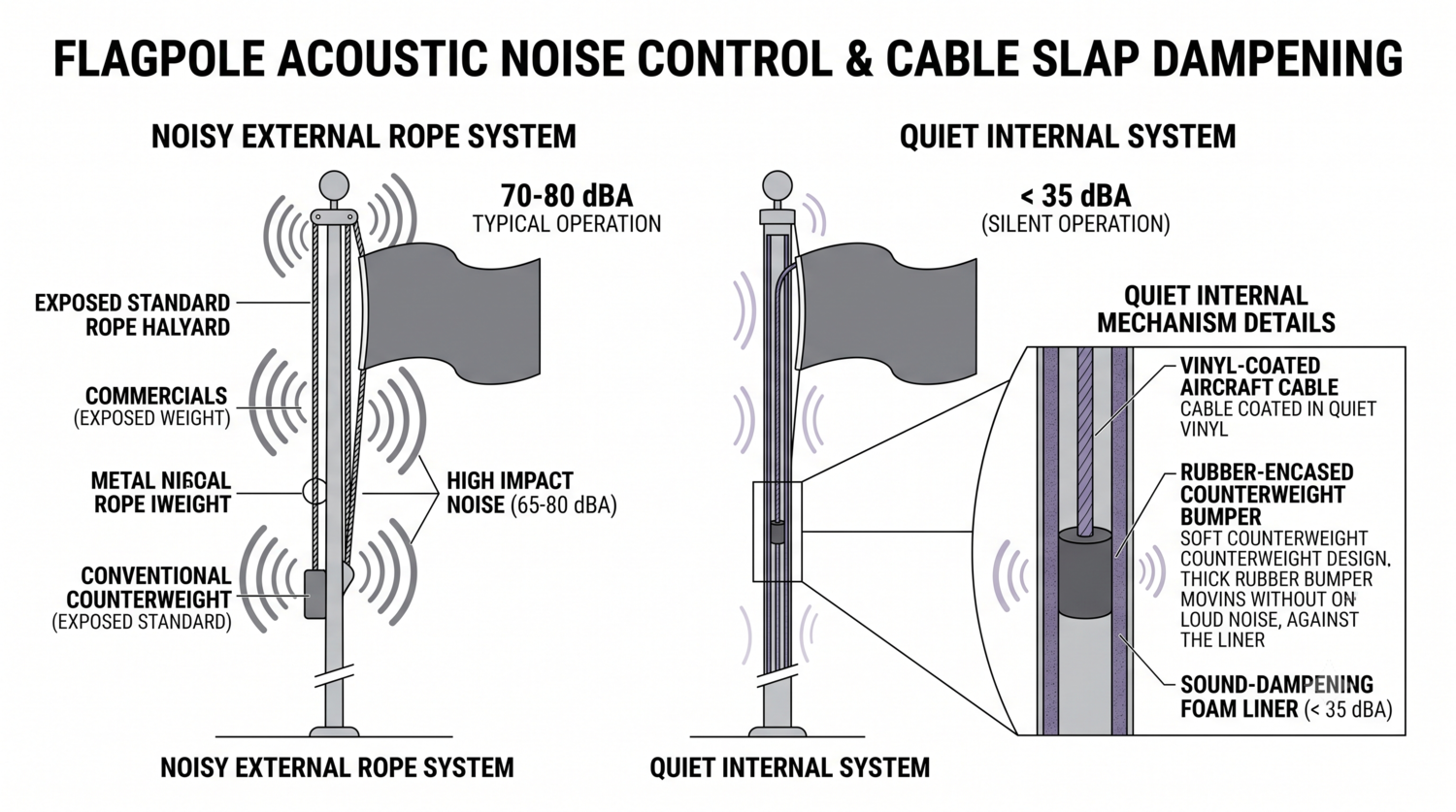
Where Does Flagpole Noise Come From?
Flagpole noise usually comes from impact, friction or vibration. An external rope or cable can strike the shaft during gusts. A counterweight can touch the inner wall as the flag rotates. A winch or cleat can create mechanical clicking during operation. Vibration can also travel through the base plate, anchors and supporting structure.
Before choosing hardware, record the project conditions:
- Distance to guest rooms, patient rooms, balconies and residential windows.
- Nighttime background noise and local noise-control requirements.
- Typical wind direction, gust range and flag operating schedule.
- Flag size, halyard arrangement, counterweight mass and cable tension.
- Shaft material, internal diameter, joint configuration and base connection.
- Access for cleaning, lubrication, adjustment and replacement.
External Cable Slap and Internal Halyards
An exposed rope or cable is easier to inspect, but it can move against the shaft and nearby hardware in windy conditions. The resulting sound level is not fixed because it changes with wind, tension, material, impact angle and site reflections.
An internal halyard can move the main rigging path inside the hollow shaft. This may reduce direct metal-to-metal impact, but the internal components still need guides, clearances, drainage and service access. A design should not assume that an internal system is silent without checking the winch, cable, counterweight and shaft interface.
Coated Wire Rope and Damped Counterweights
Flexible wire rope with a suitable polymer jacket can cushion contact between the cable and the inner wall. The jacket material must be selected for ultraviolet exposure, temperature, flexibility, abrasion and compatibility with pulleys or guides.
Counterweights should be designed so that they cannot freely strike the shaft. Possible measures include elastomeric sleeves, guide rings, soft bumpers or a controlled guide path. EPDM, polyurethane, neoprene and other materials have different temperature and ageing properties, so the selected compound should be documented.
Rubber encapsulation may reduce impact noise, but it does not remove the need for inspection. Check wear, cracking, compression set, water retention and attachment security during maintenance.
Winch, Cleat and Base Vibration
Mechanical noise can originate from the winch, gear train, bearings, cleats or flag hardware. A quiet specification should identify the normal operating sound, lubrication method, service interval and replacement parts. “Silent winch” should be treated as a design objective unless supported by a defined test method.
At the base, resilient pads or isolation washers may reduce vibration transfer, but they must not compromise anchor preload, structural capacity, grounding, drainage or long-term weather resistance. The complete base assembly should be reviewed by the structural engineer.
Interior Lining and Shaft Geometry
Acoustic lining inside a shaft may absorb some internal reflections, but it should be used only after checking moisture, drainage, fire requirements, temperature, inspection access and interference with moving parts. Open-cell foam is not automatically suitable for a wet or outdoor cavity.
Shaft geometry also affects noise. Internal ledges, rough welds, exposed fasteners and poorly aligned guides can create additional contact points. Where a continuous interior path is proposed, the supplier should provide drawings showing joints, cable clearances, access openings and serviceable components.
Acoustic Performance Review Matrix
| Environment | Main risk | Possible design response | Verification |
|---|---|---|---|
| Hotels and resorts | Nighttime complaints from guest rooms and balconies | Internal halyard, coated cable and damped counterweight | Nighttime baseline and representative wind test |
| Hospitals and care facilities | Sensitivity near patient and recovery areas | Internal moving parts, controlled access and base isolation review | Acoustic consultant acceptance criteria |
| Residential developments | Structure-borne vibration and reflected sound | Avoid impact points and review the foundation connection | Facade and boundary measurement where required |
| Commercial or industrial sites | Mechanical wear and maintenance noise | Durable rigging, accessible service points and regular inspection | Operational inspection and maintenance records |
Retrofit Options for Existing Noisy Flagpoles
Existing external-rope flagpoles can sometimes be improved without complete replacement. Potential measures include replacing hard metal contact points with polymer-coated hardware, adding controlled cable guides, improving cable tension, installing resilient bumpers and relocating the winch where the structure permits.
A retrofit should begin with observation during the complaint condition. Record wind, flag movement, contact points, operating position and the location where the sound is heard. Do not add foam, pads or loose weights without checking drainage, access, fire considerations and mechanical clearance.
Questions for the Supplier and Acoustic Consultant
- Which component is the measured or suspected noise source?
- What test distance, wind condition and microphone position are used?
- Is the reported dBA value measured, calculated or only an engineering target?
- What cable jacket, bumper material and temperature range are specified?
- How are internal parts inspected, cleaned and replaced?
- Will base isolation affect grounding, anchor preload or structural capacity?
Frequently Asked Questions
Are internal halyards always quieter than external ropes?
Not automatically. Internal halyards can reduce direct external impact, but winches, guides, counterweights and internal clearances must also be designed and maintained correctly.
Can a flagpole supplier guarantee a specific dBA level?
Only when the test method, wind condition, measurement location, operating state and background noise are defined. A general dBA claim without test conditions should not be treated as a project acceptance result.
Is acoustic foam suitable inside every flagpole?
No. Moisture, drainage, temperature, fire requirements and moving-part clearance must be reviewed before any internal liner is selected.
References
- ANSI and ASA acoustic standards resources
- NAAMM Guide Specifications for Design of Metal Flagpoles
- ASTM acoustic and building sound transmission standards
Fortune Pole can discuss internal halyards, coated wire rope, counterweight damping and project-specific noise-control requirements. Final acoustic targets should be confirmed by the responsible acoustic consultant and measured under agreed test conditions.