


Monumental Flagpole Lighting Guide
Monumental Flagpole Lighting Guide
Lighting a monumental flagpole requires coordination between architecture, electrical design, aviation safety, photometric performance and maintenance. A suitable system should illuminate the flag and shaft without creating unnecessary glare, light spill or interference with nearby facilities.
- Confirm whether aviation obstruction marking or lighting applies to the site.
- Use the current requirements of the local civil aviation authority and project consultant.
- Coordinate floodlight aiming, shielding, uniformity and maintenance access.
- Separate lighting cables from moving halyards and mechanical equipment.
- Provide grounding, surge protection, controls and backup arrangements where required.
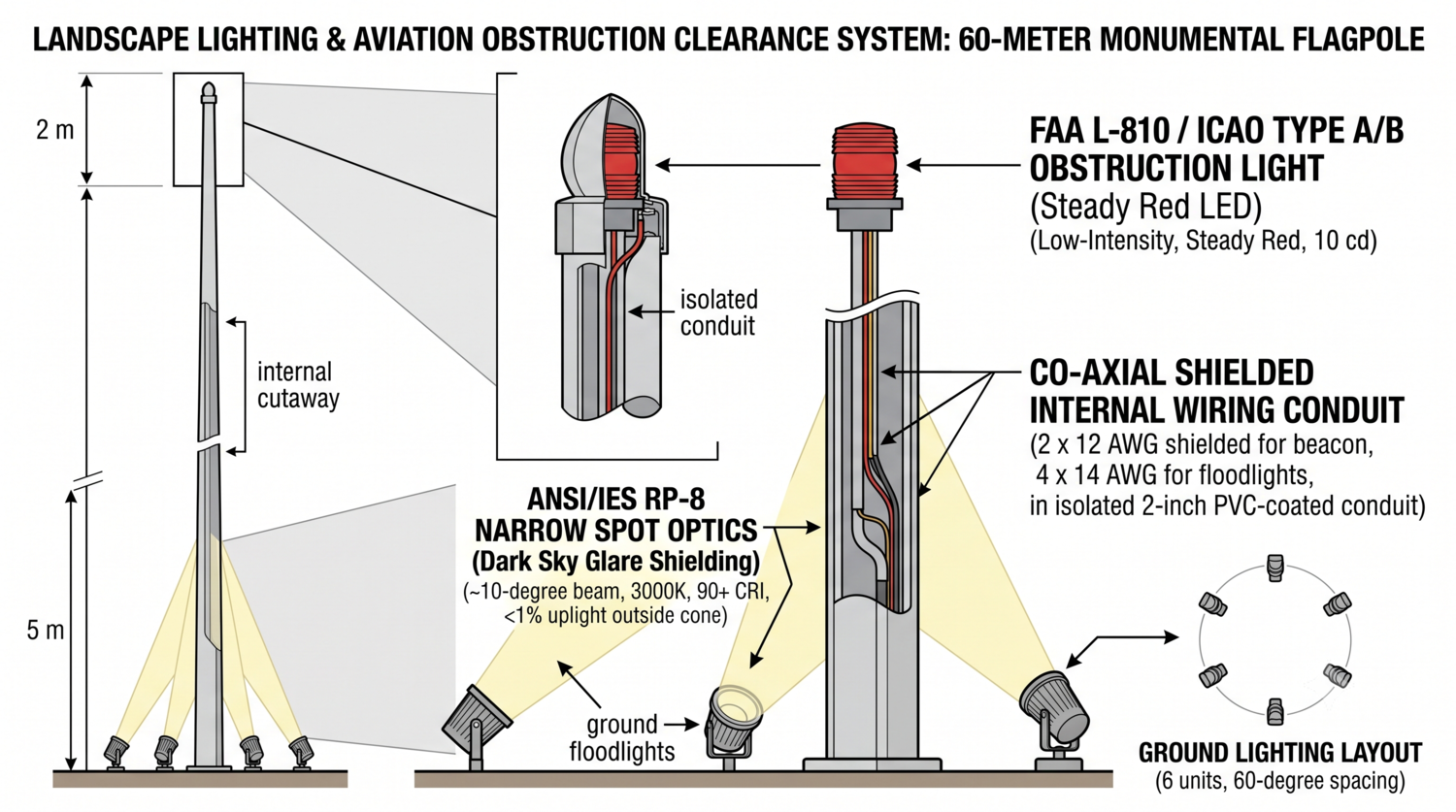
1. Start With an Aviation and Site Review
The need for obstruction marking or lighting is not determined by height alone. Location, proximity to airports, approach and departure paths, surrounding terrain, structure type and local regulations may all affect the decision.
In the United States, FAA AC 70/7460-1M provides guidance for obstruction marking and lighting. International projects may refer to ICAO Annex 14 together with the requirements of the local civil aviation authority. The owner and design consultant should confirm the applicable approval route before equipment is selected.
2. Define the Lighting Objectives
A monumental flagpole project may require several separate lighting objectives: illuminating the flag, highlighting the shaft, lighting the base landscape, providing aviation obstruction marking or supporting ceremonial events.
These functions should not automatically use the same fixture or control circuit. The design brief should state operating hours, color temperature, dimming, emergency operation, maintenance access, public visibility and any restrictions on upward light.
3. Use Photometric Design Rather Than Fixture Count Alone
Ground-mounted floodlights should be selected and aimed through a photometric study. The study should consider pole height, flag size, fabric movement, fixture elevation, beam angle, surface reflectance and viewing angles.
Multiple fixtures may improve uniformity, but the correct number and location depend on the actual geometry. A lighting designer should review average illumination, maximum-to-minimum uniformity, glare, spill light and the effect of wind-driven flag movement.
4. Control Glare and Upward Light
Uncontrolled floodlights can create glare for drivers, pedestrians, neighboring buildings and nearby residences. They may also produce unnecessary skyglow. Use aiming, shielding, louvers, visors and appropriate beam distributions to keep light on the intended surface.
Dark-sky requirements vary by jurisdiction. The specification should identify the applicable local ordinance or owner standard instead of claiming universal Dark Sky compliance. Final aiming should be checked at night after installation.
5. Coordinate Aviation Obstruction Lights
When aviation lighting is required, the beacon type, color, intensity, flash pattern, location, monitoring and backup power must follow the approved aviation determination and applicable authority requirements.
A flagpole supplier should provide mounting details, cable routing, service access, equipment data and interface information. The supplier should not independently select an FAA or ICAO light configuration without the project’s aviation approval.
6. Plan Internal Electrical Routing
Power and control cables should be routed through protected pathways and kept clear of moving halyards, winches and other mechanical components. The design should address cable support, abrasion protection, water entry, inspection access, grounding and separation from communication systems.
Junction boxes, glands and enclosures should match the exposure environment and the electrical code. Where equipment is mounted at the top of a tall shaft, the design should also address lifting, replacement, lightning protection and safe maintenance access.
7. Coordinate the Shaft and Mounting Platform
Top-mounted lights, brackets and cable pathways add weight and wind area. The structural design should include the actual equipment, brackets, cables and maintenance loads. The shaft, base connection and foundation must be reviewed as one system.
Factory-fabricated sections or one-piece shafts can reduce field assembly, but transport, crane access, lifting points and site restrictions still need to be checked. The final mounting details should be shown on approved shop drawings.
8. Lighting Specification Matrix
| Design area | Main question | Required review |
|---|---|---|
| Aviation | Does the structure require marking or lighting? | Civil aviation determination and local approval |
| Photometry | Is the flag illuminated evenly without excessive spill? | Photometric model and nighttime aiming |
| Electrical | Are cables protected and serviceable? | Routing, grounding, enclosure and maintenance review |
| Structure | Can the shaft and foundation support the lighting system? | Structural calculations and approved shop drawings |
9. Commissioning and Maintenance
- Verify fixture aiming, shielding, controls and operating modes after installation.
- Test aviation lights and monitoring functions according to the approved procedure.
- Inspect cable glands, junction boxes, brackets and grounding connections.
- Clean lenses and remove dirt, salt or debris that affects light output.
- Keep lighting schedules, test records, replacement parts and authority approvals.
Frequently Asked Questions
Does every tall flagpole require aviation obstruction lighting?
No. The requirement depends on location, height, airspace, nearby aerodromes, aviation studies and the applicable authority. The project team should obtain a formal determination where required.
Can landscape floodlights replace aviation obstruction lights?
No. Landscape fixtures and aviation obstruction lights serve different functions. Any required aviation light must follow the approved aviation specification.
How can glare be reduced near roads?
Use photometric aiming, shielding, louvers and suitable beam distributions. Final nighttime aiming should confirm that light is directed toward the flag and not into drivers’ or residents’ direct views.
Why should lighting cables be separated from halyards?
Separation reduces abrasion, entanglement and maintenance conflicts between electrical wiring and moving mechanical equipment.
References
For flagpole lighting coordination, electrical integration and project submittals, visit Fortune Pole.