


Key Takeaways
External halyard systems offer mechanical simplicity and lower upfront cost, but exposed rope is easier to access, weathers faster, and can create rope-slap noise in wind.
Internal halyard systems use concealed rope or stainless steel cable to improve site security, reduce noise, and protect rigging hardware from unauthorized access.
Motorized flagpole systems are most useful for tall poles, stadium arrays, monumental projects, and sites where synchronized or low-labor flag raising is required.
For any internal or motorized system, access-door reinforcement, cable path design, waterproofing, and maintenance access must be considered during specification.
When specifying structural equipment for corporate plazas, government municipal centers, schools, hotels, or athletic arenas, selecting the flagpole control mechanism is a critical decision. The choice affects long-term maintenance cost, site security, operator workload, noise control, and the way the pole is checked against wind-load requirements.
At Fortune Pole (Nantong Fortune Pole Co., Ltd.), our team manufactures commercial flagpoles and flagpole components for international projects. This guide explains the practical differences between external halyard, internal winch, and automated motorized systems so architects, contractors, facility managers, and procurement teams can match the control system to the project environment.
1. External Halyard Systems: Simple, Economical, and Easy to Service
The external halyard configuration is the traditional rigging design for many standard commercial installations. It uses an exposed synthetic rope, commonly braided nylon or polypropylene, running through a fixed pulley or truck assembly at the top of the flagpole. The rope is tied off at a cleat near the lower section of the shaft.
This design is simple to understand and easy to operate. It is often suitable for smaller commercial sites, temporary installations, low-risk public areas, and budget-sensitive projects where a facility team can inspect and replace the rope when needed.
The tradeoff is exposure. The rope is visible and accessible, so it can be affected by UV radiation, atmospheric moisture, abrasion, vandalism, and unauthorized handling. In windy sites, an untensioned external rope can strike the pole shaft and create rope-slap noise. For hotels, hospitals, schools, office campuses, and residential-adjacent areas, that acoustic issue can become a real maintenance complaint.
2. Internal Halyard Systems: Better Security and Reduced Noise
Internal halyard systems move the lifting mechanism inside the hollow flagpole shaft. The active line is concealed, which makes the system more secure and removes most rope-slap noise. This design is commonly specified for government buildings, schools, corporate headquarters, hotels, and sites where public access to the pole base cannot be fully controlled.
Internal systems usually fall into two categories: rope-based cam-cleat systems and gear-driven winch systems. For larger architectural installations, a gear-driven winch is often preferred because it provides mechanical advantage and better control. A stainless steel cable runs over an internal rotating truck assembly and down to a lockable access door, where the operator uses a removable hand crank to raise or lower the flag.
Access-Door Reinforcement
An internal winch system needs an access door in the lower section of the flagpole. Because a flagpole acts like a cantilevered hollow beam, cutting an opening into the shaft can create a stress concentration if the area is not properly reinforced. Project specifications should require engineered reinforcement around the access aperture, especially for taller poles and high-wind locations.
For projects that require formal structural review, the flagpole design should be checked against applicable wind-load requirements and relevant metal flagpole standards, including ASCE/SEI 7-22 and NAAMM FP 1001-07. The final pole size, wall thickness, base detail, and foundation design should be verified by the project engineer.
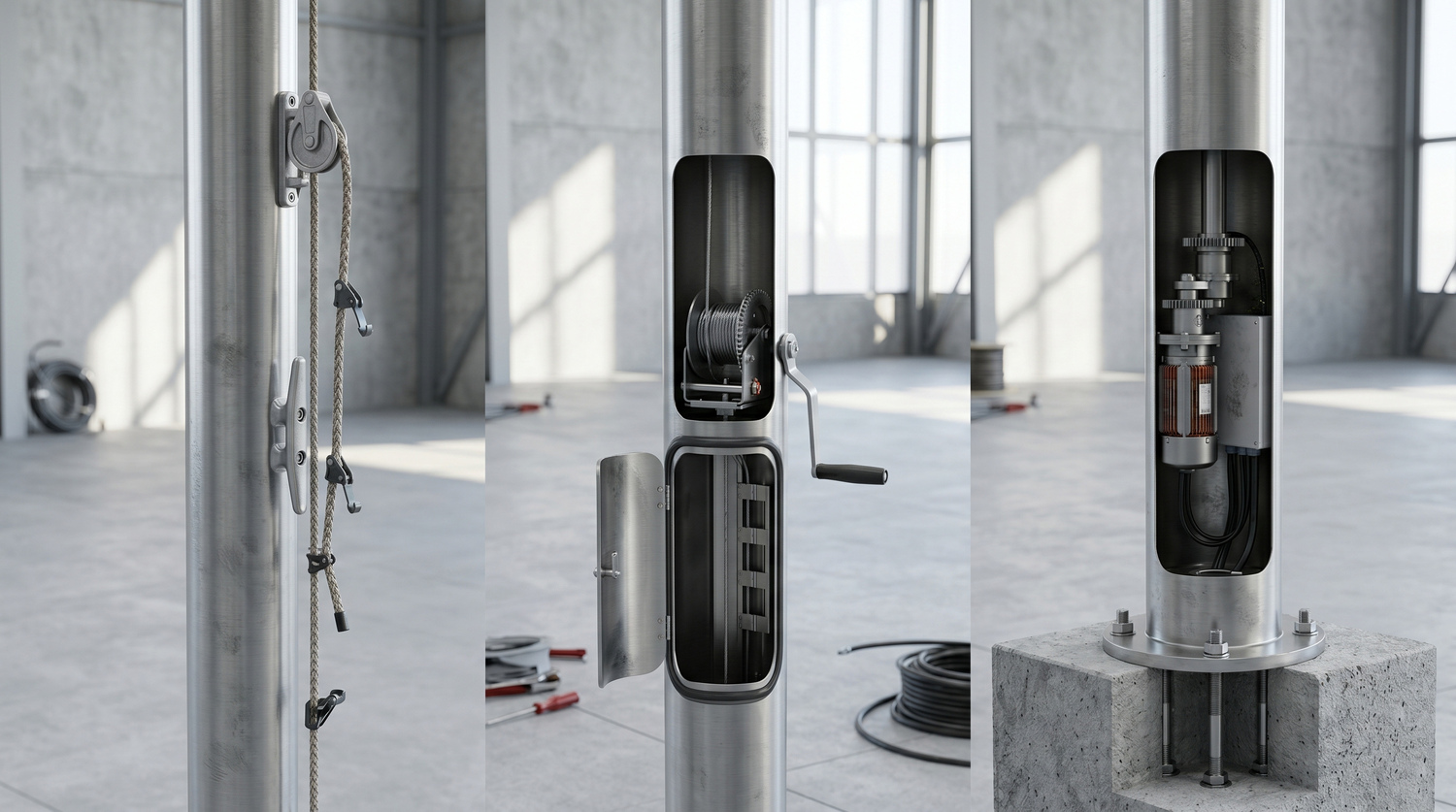
Figure 1: Typical comparison of external cleat rigging, internal winch control, and motorized flagpole operation.
3. Automated Motorized Systems: Low-Labor Operation for Tall or High-Profile Sites
For tall flagpoles, large public plazas, stadium flag arrays, and landmark projects, manual operation can become inefficient. The total flag weight, cable friction, operating height, and frequency of use may justify a motorized system. Fortune Pole's flagpole project case studies show how project context, site scale, and user requirements affect system selection.
Motorized flagpole systems typically use an electric motor, gearbox, control cabinet, and internal lifting mechanism. Depending on the project, the system can be configured for local button control, remote operation, timed raising and lowering, or synchronized movement across multiple poles.
For event venues and stadium arrays, synchronization is often more important than raw speed. A well-specified system should define the raising speed, control tolerance, emergency stop behavior, power requirements, drainage design, and maintenance access. Sensitive electrical components should be protected from moisture and dust with appropriately rated enclosures, commonly specified according to the project environment and IEC 60529 IP-rating requirements.
4. Engineering Performance Comparison
Notice: The following values are preliminary guidance only. They do not replace project-specific engineered calculations. Final sizing must be verified by a licensed engineer or a qualified structural/geotechnical report using the applicable local code, wind speed, exposure category, flag size, shaft material, wall thickness, and foundation condition.
| Mechanical Metric | External Halyard System | Internal Winch System | Automated Motorized System |
|---|---|---|---|
| Line/Cable Material | Braided nylon or polypropylene rope | Stainless steel cable with internal winch | Wire rope, gearbox, and motorized drive system |
| Security Profile | Basic; exposed rope and cleat | High; lockable access door | High; controlled operation and restricted access |
| Acoustic Behavior | May create rope-slap noise in wind | Low noise because rigging is internal | Low noise with internal drive components |
| Typical Height Range | 6m to 10m / 20ft to 35ft | 9m to 24m / 30ft to 80ft | 18m+ / 60ft+ and project-specific tall poles |
| Maintenance Focus | Rope wear, cleat, pulley, and snap hooks | Cable tension, winch, door lock, and truck assembly | Motor, gearbox, controls, waterproofing, and override system |
5. Which System Should You Specify?
Choose an external halyard system when the project is small, budget-sensitive, easy to access, and located where rope noise or public tampering is not a major concern.
Choose an internal winch system when the project needs stronger security, lower noise, a cleaner architectural appearance, and better protection for rigging hardware. This is usually the better choice for government, school, hotel, corporate, and high-traffic public sites.
Choose an automated motorized system when the pole is tall, the flag is heavy, the site requires synchronized operation, or facility teams need to reduce manual lifting work. For very tall installations, the control system should be reviewed together with the shaft design, foundation, power supply, drainage, and maintenance plan.
For related design decisions, see Fortune Pole's guides on 304 vs. 316L stainless steel flagpoles and commercial flagpole foundation design.
Technical Siting Questions
How does the wind-load calculation change for internal halyard poles with access doors?
The access opening changes the local section properties of the shaft. Project specifications should require engineered reinforcement around the door cavity so the access zone can resist concentrated bending demand under wind load. The exact reinforcement method should be confirmed by the manufacturer and project engineer.
What backup systems exist if an automated flagpole loses power?
Professional motorized flagpoles can be specified with a manual override. Depending on the drive design, a secure clutch or service access point allows facility teams to operate the lifting mechanism manually during power loss, control failure, or scheduled maintenance.
Can an existing external halyard flagpole be upgraded to an internal or motorized system?
Retrofitting may be possible, but it requires structural validation. Converting to an internal winch may require a new truck assembly and a reinforced access aperture. Motorized automation requires enough base diameter, foundation capacity, and service access for the drive system. In many projects, replacing the pole is more reliable than retrofitting an old shaft.
Related Fortune Pole Resources
References
NAAMM FP 1001-07 Guide Specifications for Design of Metal Flagpoles
ASCE/SEI 7-22 Minimum Design Loads and Associated Criteria for Buildings and Other Structures
International Building Code, Chapter 18: Soils and Foundations
Need Help Specifying a Commercial Flagpole System?
Fortune Pole can support project-specific flagpole selection, including shaft material, surface finish, rigging system, control method, wind-load coordination, foundation interface, and custom accessories. For a project review or quotation, contact the Fortune Pole team through the contact page.