


High-Security Flagpole Engineering Guide
High-Security Flagpole Engineering Guide
Flagpoles installed at military, diplomatic, government or other controlled facilities require more than a standard commercial specification. The project team should review site access, security risks, wind loads, foundation design, maintenance procedures and approval requirements before procurement.
- Define the security and structural design basis before selecting the flagpole system.
- Coordinate the access panel, halyard or winch and locking hardware with the facility security plan.
- Design the base connection and anchor cage for the verified wind and project loads.
- Require site-specific engineering review for blast, impact or other unusual hazards.
- Document inspection, key control, maintenance and replacement procedures.
1. Define the Facility Risk Profile
The first step is to identify the facility type, location, public access conditions and operational requirements. A flagpole at a secured government entrance may require different access controls from a ceremonial pole at a military headquarters or diplomatic compound.
The design brief should identify restricted areas, maintenance access, key or credential control, emergency procedures, nearby vehicle routes, perimeter barriers and any requirements from the owner, security consultant or authority having jurisdiction.
2. Establish the Structural Design Basis
Standard wind design and unusual dynamic hazards should be treated as separate design questions. Local building codes, project criteria and applicable standards should define the basic wind loads, exposure, importance category and service conditions.
If a project includes blast, vehicle impact, seismic or other exceptional hazards, the responsible structural and security engineers must define the threat assumptions, performance objectives, load cases and acceptance criteria. A commercial flagpole product should not be described as blast-resistant without project-specific analysis and evidence.
3. Coordinate Secure Access Components
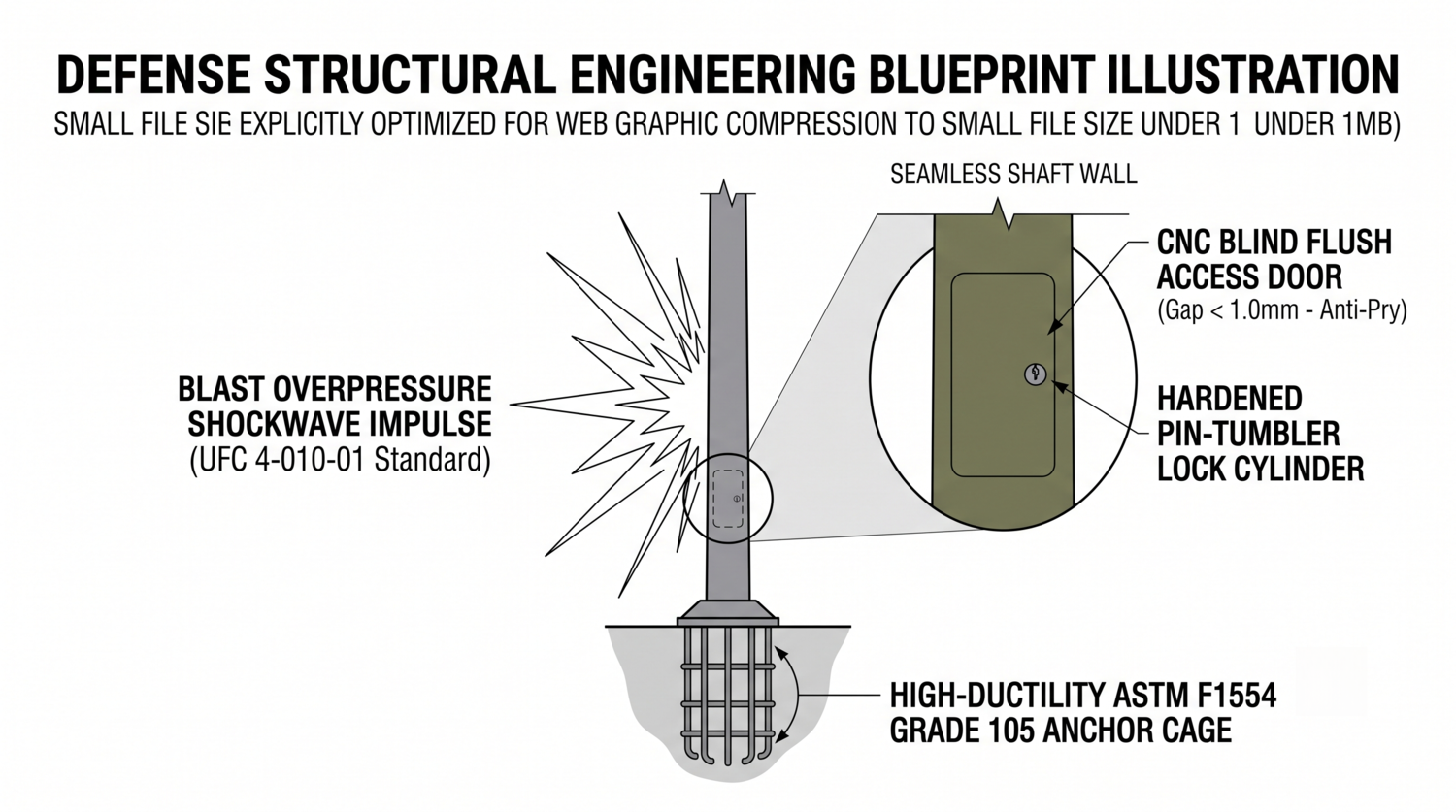
High-security facilities commonly require a clean exterior profile and controlled access to the flag-handling equipment. Depending on the approved design, the system may use a flush access panel, an internal halyard, a manual winch or another concealed operating arrangement.
The access assembly should be reviewed for tamper resistance, weather sealing, corrosion protection, key management, inspection access and safe operation. Locking hardware must be compatible with the facility’s security policy and should not be selected only from a general commercial catalog.
4. Review the Foundation and Anchor Cage
The foundation transfers the flagpole loads into the soil and surrounding structure. Review the foundation dimensions, concrete strength, reinforcement, anchor cage geometry, bolt projection, leveling method, drainage and finished grade.
Anchor materials and connection details should be selected from the approved structural design. High-strength anchor rods may be appropriate for some projects, but the grade alone does not establish the performance of the complete foundation system. Concrete breakout, edge distance, base plate behavior and installation tolerances also require review.
5. Select the Shaft and Finish
The shaft material, wall thickness, taper, access arrangement and finish should match the design loads and exposure conditions. Stainless steel, aluminum and coated steel can each be suitable in different environments when supported by the project specification.
Finish documents should identify the coating or anodizing system, surface preparation, color, inspection method and maintenance requirements. Avoid relying on general terms such as “military grade” or “maintenance free” without supporting technical information.
6. Plan Installation and Maintenance
Security-sensitive sites may restrict working hours, lifting areas, photography, contractor access and hot work. The supplier should provide a practical installation method that addresses transport, crane access, exclusion zones, temporary stability and final inspection.
The handover package should include operating instructions, key or access-control information, inspection intervals, lubrication requirements, spare parts and procedures for reporting damage or unauthorized access.
7. High-Security Specification Matrix
| Design area | Review question | Required evidence |
|---|---|---|
| Site risk | What hazards and access restrictions apply? | Owner brief and approved design criteria |
| Access hardware | Who can operate or inspect the internal equipment? | Hardware schedule and security approval |
| Base connection | Can the foundation resist the verified project loads? | Structural calculations and anchor details |
| Handover | Can the facility maintain and inspect the system safely? | Operation and maintenance manual |
8. Documents to Request Before Purchase
- General arrangement and foundation connection drawings.
- Wind-load assumptions and structural calculation requirements.
- Access panel, lock, halyard or winch details.
- Material, coating and corrosion-protection data.
- Installation method statement and lifting plan.
- Inspection, maintenance and spare-parts information.
- Project-specific hazard assessment where unusual loads are present.
Frequently Asked Questions
Can a standard commercial flagpole be used at a high-security facility?
It may be possible for low-risk areas, but the system must satisfy the facility’s structural, access-control and maintenance requirements. The responsible project team should approve the final specification.
Does a high-strength anchor rod make a flagpole blast-resistant?
No. Blast performance depends on the complete load path, foundation, shaft, base plate, connections, surrounding structure and defined threat scenario. It requires project-specific engineering.
Why use a concealed halyard or internal winch?
These arrangements can reduce exposed operating hardware and support controlled maintenance access. The final configuration should be selected according to the security plan and operating needs.
What should be included in a secure-facility submittal?
The submittal should show dimensions, materials, loads, base connection, access hardware, finish, installation method, inspection requirements and any assumptions requiring owner approval.
References
For high-security flagpole engineering coordination and project submittal support, visit Fortune Pole.