


GCC Flagpole Material Compliance Guide
GCC Flagpole Material Compliance Guide
Commercial flagpoles for Gulf Cooperation Council projects require more than a standard product brochure. Contractors and consultants may need to coordinate material traceability, client specifications, corrosion exposure, wind calculations, welding records, inspection plans and final submittal documents.
1. Start With the Project Compliance Basis
Before selecting the flagpole, identify the project location, client, consultant, authority having jurisdiction, applicable local code, design wind criteria, flag dimensions, foundation requirements and environmental exposure.
Saudi Aramco, SABIC, government, infrastructure and private development projects may use different procurement procedures and technical requirements. References to a company standard should therefore be verified against the current project specification, approved vendor list, purchase order and inspection plan.
2. Evaluate GCC Environmental Exposure
Gulf projects can combine high temperature, intense ultraviolet radiation, humidity, airborne chloride, sand, condensation during nighttime cooling and, in industrial zones, chemical exposure. Coastal locations along the Red Sea or Arabian Gulf require a specific corrosion review rather than a generic material selection.
Material selection should consider the substrate, alloy grade, wall thickness, surface finish, fasteners, weld zones, drainage and maintenance access. Stainless steel, aluminum and coated carbon steel may each be appropriate for different conditions when supported by project calculations and product documentation.
3. Material Traceability and MTR Documents
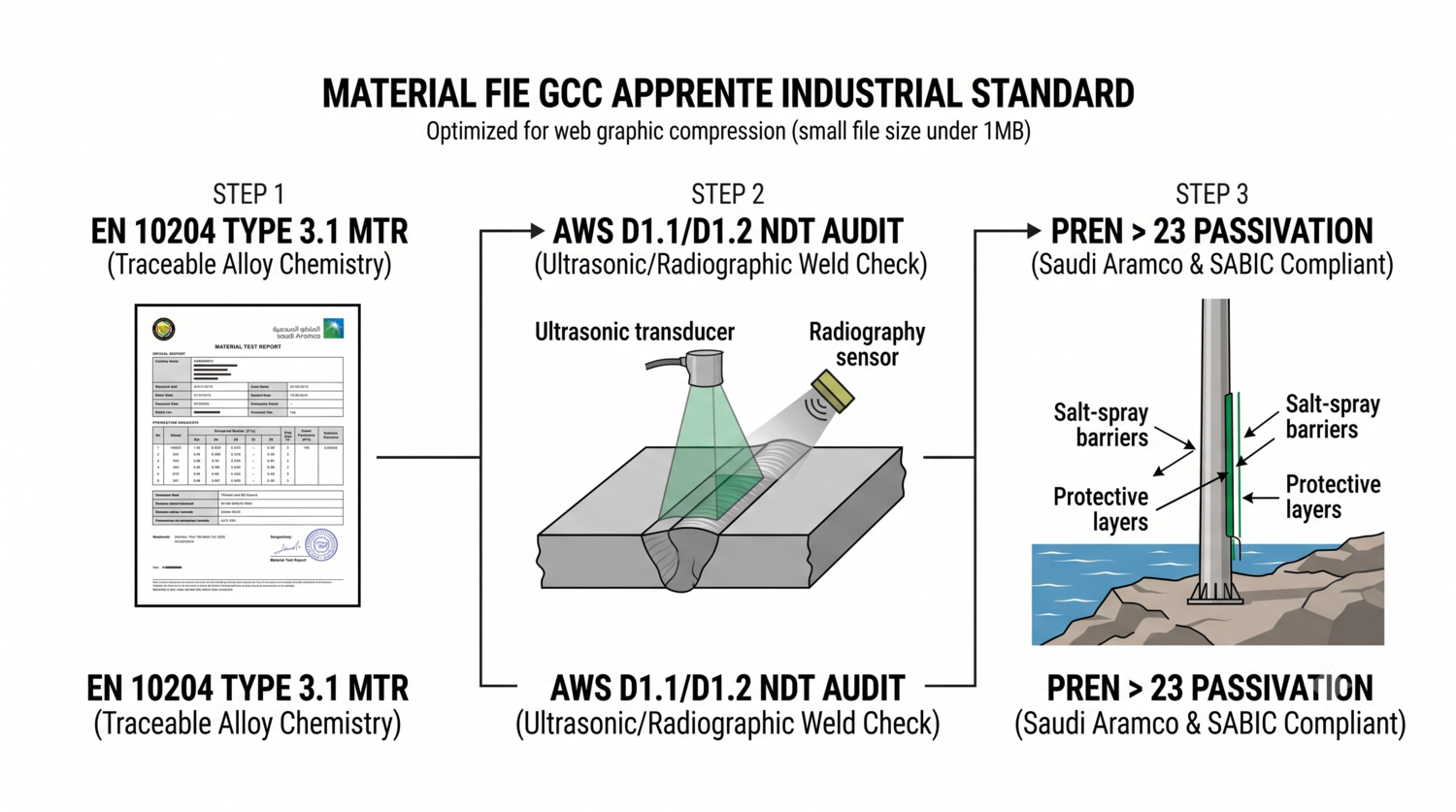
Material Test Reports should identify the actual production batch and connect the supplied material to the finished flagpole. Depending on the contract, the submittal may require chemical composition, mechanical properties, heat number, product dimensions, standard designation and the manufacturer’s quality approval.
EN 10204 Type 3.1 or 3.2 documentation may be requested by a project, but the exact certificate level and third-party involvement must be confirmed in the approved procurement documents. Do not promise a specific certificate type unless it is available for the selected material and required by the client.
4. Welding, Fabrication and Inspection
The fabrication package should define the welding procedure, qualified personnel, base material, filler material, joint design, heat input, repair method and inspection hold points. Visual inspection is common, while ultrasonic, radiographic, dye penetrant or magnetic particle testing should be applied when required by the approved specification or inspection and test plan.
For long shafts and sectional connections, document dimensional checks, straightness, joint fit-up, anchor interfaces, lifting points and final assembly requirements. Factory-controlled fabrication can improve consistency, but it does not replace the client’s required inspection records.
5. Corrosion Protection and Surface Finish
For aluminum architectural surfaces, the project may specify anodizing or an organic coating system qualified under an applicable performance specification such as AAMA 2605. The suitability of the finish depends on the substrate, color, pretreatment, film thickness, exposure and repair method.
For stainless steel, review grade, surface finish, weld cleaning, passivation, chloride exposure and contact with dissimilar metals. For coated steel, specify surface preparation, primer, coating system, dry film thickness, adhesion testing and repair procedures.
6. Wind Design and Structural Documents
Flagpole calculations should reflect the actual height, shaft geometry, flag area, exposure category, design wind speed, attachments, foundation and local code. NAAMM FP 1001 provides guidance related to flagpole wind pressure, flag loading, bending moments, shear, torsion and stress analysis.
In North American-based design work, ASCE/SEI 7-22 may be relevant to environmental loading. The governing project code and engineer-approved criteria remain controlling.
7. One-Piece and Sectional Flagpoles
A one-piece shaft can reduce some field joints, but transportation, lifting, road access and site restrictions may require a sectional design. Sectional construction is not automatically unsuitable when the joint details, sleeves, fasteners, welding, inspection and installation sequence are properly documented.
The procurement package should identify the selected configuration, connection details, tolerances, lifting method, site assembly procedure and responsibilities for field inspection.
8. GCC Material Submittal Checklist
| Document | Information to include | Review focus |
|---|---|---|
| Material certificates | Grade, heat number, chemistry and mechanical properties | Traceability to supplied components |
| Welding package | WPS, qualifications, joint details and repair method | Compliance with project ITP |
| Inspection records | VT and required NDT reports | Inspector qualifications and acceptance criteria |
| Structural calculations | Wind loads, shaft stresses, base reactions and foundation data | Engineer approval and local code |
| Finish certificate | Pretreatment, thickness, adhesion and repair procedure | Environmental suitability |
9. Practical Procurement Checklist
- Confirm the client’s current specification and approved vendor requirements.
- Identify the design wind criteria, flag area and attachment loads.
- Define coastal, industrial, sand and ultraviolet exposure.
- Request batch-specific material certificates and traceability records.
- Submit welding procedures and inspection plans for review.
- Confirm coating, anodizing, passivation and repair requirements.
- Provide structural calculations and foundation interface drawings.
- Agree on inspection points, document format and approval responsibilities.
Frequently Asked Questions
Does a flagpole need a universal Saudi Aramco or SABIC certificate?
There is no single certificate that replaces the project requirements. The required documents depend on the client, contract, material, location, approved specification and inspection plan.
Are EN 10204 Type 3.1 documents always mandatory?
Not for every project. Type 3.1 or 3.2 certification may be requested, but the required certificate level should be confirmed in the procurement documents before production.
What is important for a coastal GCC flagpole?
Review chloride exposure, material grade, surface finish, weld treatment, dissimilar-metal connections, drainage, coating or passivation and the planned inspection interval.
Does factory-direct supply guarantee approval?
No. Factory-direct supply can simplify communication and document control, but approval still depends on the submitted evidence and the client’s technical review.
References
- Saudi Aramco official website
- SABIC quality standards
- NAAMM FP 1001: Guide Specifications for Design of Metal Flagpoles
- Fortune Pole commercial flagpole solutions
For a project-specific submittal package, provide the project location, client, flagpole height, flag dimensions, design wind criteria, material preference, finish, foundation interface and required inspection documents.