


Flagpole Anti-Corrosion Engineering Guide
Flagpole Anti-Corrosion Engineering Guide
Flagpole corrosion protection should be selected according to the site environment, material, coating system, fabrication method and maintenance plan. Coastal, industrial and high-humidity locations require more detailed specification than dry inland sites.
- Classify the exposure before selecting the material or coating system.
- Galvanizing and organic coatings can be combined when the project requires layered protection.
- Test reports should identify the coating system, preparation method and applicable standard.
- Joints, base plates, welds and drainage details need the same attention as the main shaft.
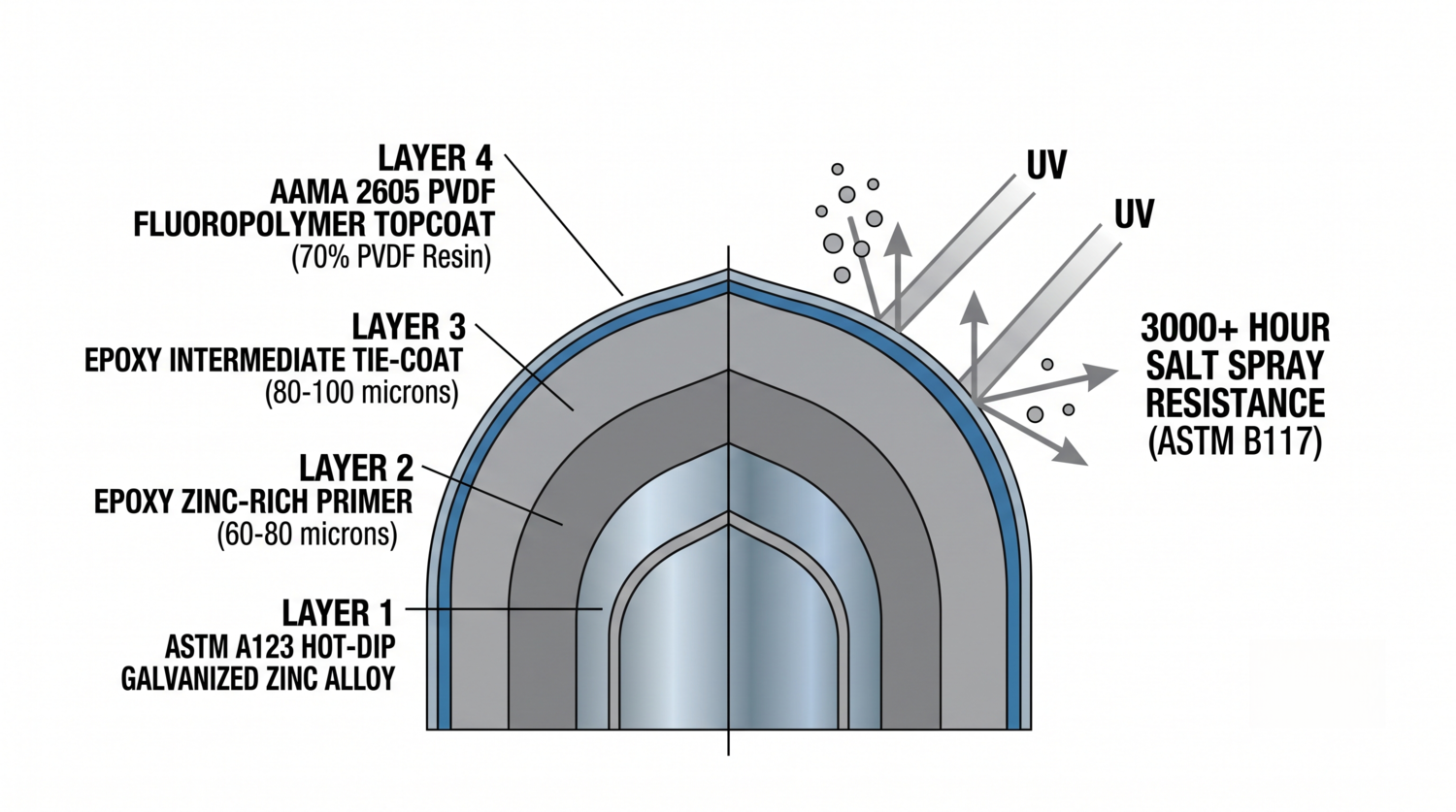
Corrosion protection should connect site exposure, materials, coating records and maintenance requirements.
1. Classify the Atmospheric Exposure
The first step is to understand the site environment. ISO 9223 can be used as a reference for atmospheric corrosivity classification, but the project team should also review airborne chlorides, humidity, pollution, temperature, splash zones and local maintenance conditions.
- Low exposure: Dry inland or sheltered locations may allow a standard architectural finish when permitted by the specification.
- Medium exposure: Urban and industrial areas may require improved surface preparation, coating control and inspection.
- High exposure: Coastal, marine and chemical environments usually require a more robust corrosion-protection system.
2. Select the Base Material
Steel, stainless steel and aluminum have different corrosion behavior and finishing requirements. The selected material should be compatible with the shaft geometry, wind design, connection details, flag hardware and expected maintenance access.
When dissimilar metals are used together, the design should consider galvanic isolation, drainage, fastener selection and coating continuity. The base material alone does not determine the service performance of the complete flagpole.
3. Understand Duplex Coating Systems
A duplex system generally combines hot-dip galvanizing with an organic coating. The zinc layer provides metallic protection, while the paint system adds a barrier against moisture, oxygen, salts and ultraviolet exposure.
Typical project documentation may include the galvanizing standard, surface preparation method, primer, intermediate coat, topcoat, dry-film thickness and repair procedure. ASTM A123 or ISO 1461 may apply to hot-dip galvanized steel when required by the specification.
4. Specify PVDF and Architectural Coatings Carefully
PVDF and other architectural coating systems should be specified by the applicable product standard, resin type, color, gloss, film thickness, preparation method and test evidence. AAMA 2605 may be relevant for superior-performing organic coatings on aluminum extrusions.
Coating performance depends on the complete system. Poor cleaning, incorrect pretreatment, incompatible layers, sharp edges, trapped moisture or field damage can reduce performance even when the topcoat is correctly specified.
5. Use Testing as Verification
ASTM B117 salt spray testing can be used to compare coating resistance under a controlled laboratory exposure. It should not be treated as a direct prediction of field service life. Test duration, substrate, scribe method, coating thickness and acceptance criteria must be identified.
Other records may include adhesion testing, dry-film thickness, color and gloss measurements, galvanizing inspection, holiday testing and repair documentation. The required evidence should follow the project quality plan.
6. Reduce Corrosion Risks at Joints and Details
Crevices, overlaps, base plates, welds, access doors and fasteners can collect water and salts. Joint details should provide drainage, avoid unnecessary water traps and maintain coating continuity after fabrication and installation.
One-piece construction may reduce the number of field joints, but it is not automatically suitable for every project. Transport, lifting, manufacturing limits and site access may require sectional construction with carefully protected connections.
7. Plan Inspection and Maintenance
A maintenance plan should identify inspection intervals, wash-down requirements, coating damage, rust staining, fastener condition, sealants, drainage openings and repair materials.
Coating repair should follow the approved system. Surface cleaning, preparation, compatible materials and curing conditions should be documented before the repaired area is returned to service.
8. Corrosion Protection Checklist
| Area | Information to Confirm | Review Focus |
|---|---|---|
| Exposure | Marine, industrial, humidity and pollution conditions | Suitable corrosivity category |
| Materials | Steel, aluminum, stainless steel and fasteners | Compatibility and isolation |
| Coating | Galvanizing, primer, intermediate and topcoat | Preparation, thickness and repair |
| Testing | Salt spray, adhesion, thickness and appearance records | Evidence matches the specification |
| Maintenance | Inspection, cleaning, repair and replacement plan | Long-term serviceability |
Frequently Asked Questions
Is hot-dip galvanizing suitable for every flagpole?
No. The choice depends on the base material, exposure, appearance, dimensions, fabrication process and project specification.
Does ASTM B117 prove a specific field service life?
No. Salt spray testing provides controlled comparative evidence. Actual field performance depends on exposure, design details, installation quality and maintenance.
Is a duplex coating system always required in coastal areas?
Not automatically. The required system should be selected from the project exposure assessment, material choice, appearance requirements and maintenance plan.
Can joints be ignored when specifying corrosion protection?
No. Joints, welds, base plates, fasteners and access doors can be more vulnerable than the main shaft and should be included in the inspection plan.
References
- AAMA Aluminum Specifications
- ASTM B117 Salt Spray Testing
- ISO 9223 Atmospheric Corrosivity Classification
- Fortune Pole
For coating specifications, inspection records and marine flagpole solutions, contact Fortune Pole.