


Eurocode Flagpole Compliance Guide
Eurocode Flagpole Compliance Guide
Commercial flagpoles for European projects require more than a product catalogue. Designers, contractors and consultants may need to coordinate Eurocode wind actions, structural calculations, material selection, EN 1090 execution requirements, welding records, inspection plans and final project submittals.
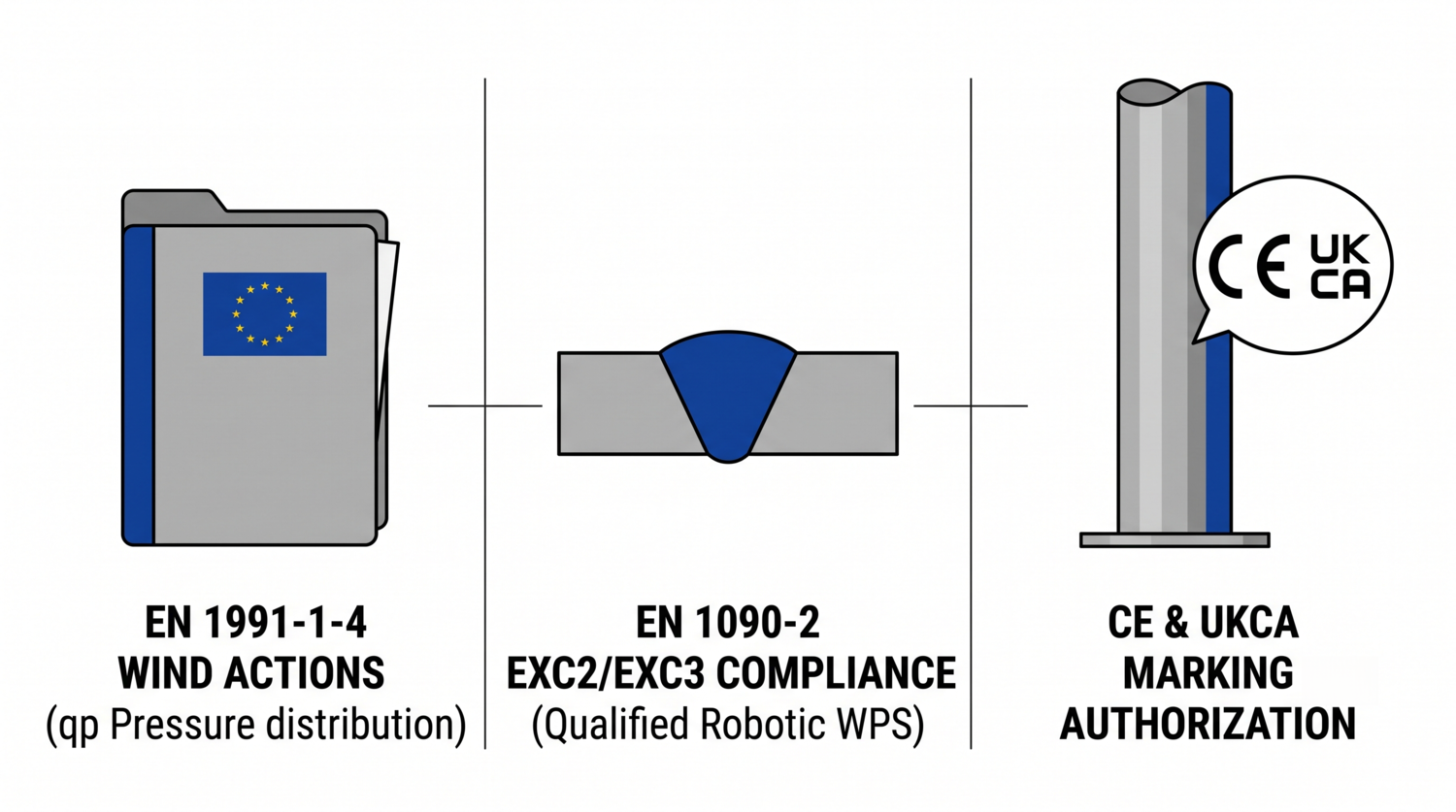
1. Establish the Project Design Basis
Start with the project location, country, National Annex, design wind criteria, terrain category, flag area, accessories, foundation interface and applicable product or construction requirements.
Projects in the European Union, European Economic Area and United Kingdom may use related but different conformity and procurement procedures. Confirm whether the project requires CE marking, UKCA-related documentation or another client-specific declaration. A supplier should not promise formal approval before reviewing the current tender and IFC documents.
2. Select the Correct Eurocode Structural Basis
Steel and aluminum flagpoles may require different structural design approaches. Eurocode 3, within the EN 1993 series, is used for the design of steel structures. Eurocode 9, within the EN 1999 series, addresses aluminum structures.
Wind actions are generally considered under EN 1991-1-4 together with the applicable National Annex. The calculation should account for basic wind velocity, terrain, altitude, direction, exposure, aerodynamic effects, flag loading and any attached equipment.
The responsible engineer should verify the shaft stresses, deflection, local buckling, connection forces, base reactions and foundation interface. A one-piece shaft may simplify some connection assumptions, but it does not replace the required structural calculation.
3. Understand EN 1090 Requirements
EN 1090 is not a single certificate that automatically approves every flagpole. EN 1090-1 relates to conformity assessment for structural components, while EN 1090-2 concerns technical requirements for steel structures and EN 1090-3 concerns aluminum structures.
Execution Class EXC1 through EXC4 is selected according to the project consequence class, structural complexity, loading and client requirements. The correct class must be confirmed by the design team and project specification. It should not be assigned only from the product height or sales category.
Where EN 1090 applies, the fabrication system may need Factory Production Control, qualified welding procedures, qualified personnel, material control and inspection records appropriate to the approved execution class.
4. Welding and Factory Production Control
The fabrication package should identify the base material, filler material, welding process, joint design, WPS, welder qualifications, repair procedure and inspection hold points. The documentation should show how the finished shaft or section is connected to the approved design.
Factory welding can improve repeatability and document control, but it does not automatically remove all inspection obligations. The required visual and non-destructive testing should follow the project inspection and test plan, applicable standards and execution class.
5. Material Certificates and Traceability
Material Test Reports should identify the supplied material and link it to the finished flagpole. Depending on the project, the submittal may include material grade, heat number, chemical composition, mechanical properties, dimensions, surface condition and supplier quality records.
EN 10204 Type 3.1 or Type 3.2 certification may be requested, but the required certificate level and third-party involvement must be confirmed in the procurement documents. These certificates are evidence of the supplied batch; they do not replace structural calculations or project approval.
6. Surface Finish and Durability
For aluminum architectural surfaces, a project may specify anodizing or a coating system qualified under a relevant performance specification such as AAMA 2605. Confirm pretreatment, film thickness, color, adhesion, repair procedure and environmental exposure.
For stainless steel, review the grade, surface finish, weld cleaning, passivation, chloride exposure and contact with dissimilar metals. For coated steel, document surface preparation, primer, coating thickness, adhesion and field repair requirements.
7. One-Piece and Sectional Flagpoles
A one-piece flagpole may reduce certain field joints, but transportation, lifting, road access and site limitations can make a sectional design more practical. Sectional construction may be suitable when sleeves, connections, tolerances, fasteners, welding and inspection are properly specified.
The procurement package should include the shaft geometry, connection details, lifting points, installation sequence, field assembly procedure and responsibility for final inspection.
8. European Submittal Matrix
| Document | Information to include | Review focus |
|---|---|---|
| Structural calculation | Wind actions, shaft stresses, deflection and base reactions | Eurocode and National Annex |
| Material certificates | Grade, heat number, chemistry and mechanical properties | Traceability to components |
| Welding package | WPS, qualifications, joint details and repairs | EN 1090 and project ITP |
| Inspection records | Visual and required NDT reports | Acceptance criteria and inspector |
| Finish documentation | Pretreatment, thickness, adhesion and repair | Environmental suitability |
9. Procurement Checklist
- Confirm the country and applicable National Annex.
- Define wind actions, flag area, accessories and foundation conditions.
- Identify whether the shaft is steel, aluminum or stainless steel.
- Confirm the required EN 1090 execution class with the design team.
- Request batch-specific material certificates and traceability records.
- Submit welding procedures and inspection plans for review.
- Confirm coating, anodizing, passivation and repair requirements.
- Agree on CE, UKCA or other project-specific conformity documents.
Frequently Asked Questions
Does every European flagpole require the same Eurocode calculation?
No. The calculation depends on the country, National Annex, project loads, shaft material, geometry, flag area and client requirements.
Is EN 1090 EXC2 mandatory for every commercial flagpole?
No. The execution class is project-specific and should be selected from the consequence, complexity, loading and approved specification.
Are EN 10204 Type 3.1 certificates always required?
No. Type 3.1 or Type 3.2 may be required by a contract, but the certificate level should be confirmed before production.
Does factory-direct supply guarantee CE approval?
No. Factory-direct supply can improve communication and document control, but conformity depends on the applicable product requirements and the evidence submitted for the project.
References
- European Commission Joint Research Centre Eurocodes
- NAAMM FP 1001: Guide Specifications for Design of Metal Flagpoles
- AAMA aluminum coating specifications
- Fortune Pole commercial flagpole solutions
For a project-specific quotation or compliance package, provide the country, client, flagpole height, flag dimensions, wind criteria, material, finish, foundation interface and required inspection documents.