


Cold-Climate Flagpole Specification Guide
Cold-Climate Flagpole Specification Guide
Cold-climate flagpole projects require more than selecting a taller shaft or a heavier base. Low temperatures, wind, snow, ice, freeze-thaw cycles, soil movement and maintenance access should be considered together during specification.
1. Start With the Actual Site Conditions
Define the lowest design temperature, basic wind speed, exposure category, expected flag area, snow or atmospheric ice, seismic conditions and operating requirements. For projects in northern regions, the specification should also identify freeze-thaw cycles, frost depth, permafrost or seasonally frozen soil, drainage and access for future maintenance.
Wind, snow, ice and other environmental loads should be established by the project engineer and applicable local code. In North American projects, ASCE/SEI 7-22 may be relevant to general environmental loading, subject to the authority having jurisdiction.
2. Select Materials by Grade and Evidence
Low temperature can change the strength, ductility, fracture behavior and corrosion performance of metals. The correct material depends on alloy grade, temper, shaft geometry, weld zones, coating system, service temperature and the design loads.
Aluminum alloys and austenitic stainless steels may be considered for cold or marine environments, but neither material should be treated as automatically suitable. Request material certificates, alloy and temper information, wall thickness, corrosion assumptions and the supplier’s temperature limits.
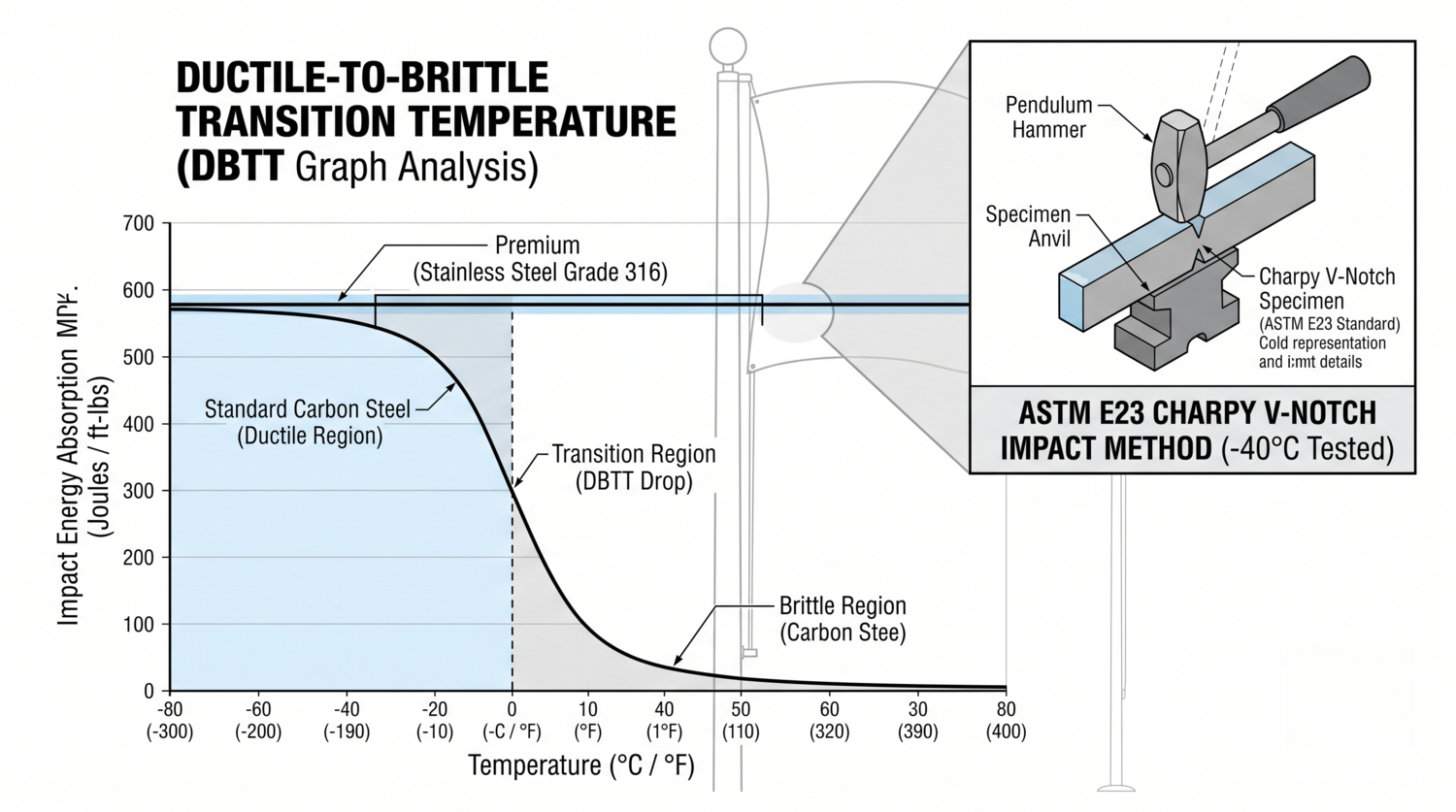
Carbon or low-alloy steels require particular attention to notch toughness and fracture resistance when the service temperature approaches the material’s transition range. The project engineer should define the required material standard and acceptance criteria.
3. Impact Testing, Welding and Inspection
ASTM E23 describes Charpy and Izod notched-bar impact testing for metallic materials. A Charpy test may be required when the project specification, material standard or engineer identifies low-temperature toughness as a design requirement. The test temperature, specimen orientation, absorbed energy and acceptance value must come from the approved specification rather than a universal number.
Cold-climate quality control should also cover welding procedures, welder qualifications, heat input, repair limits, visual inspection and any required non-destructive examination. Ask for traceability from the material certificate to the shaft section and fabrication record.
4. One-Piece and Sectional Flagpole Construction
A one-piece shaft can reduce field joints, but transportation, lifting limits, road access and installation equipment may make sectional construction more practical. Sectional poles are not automatically unsafe when joints, sleeves, welds, fasteners and inspection requirements are properly engineered.
The supplier should provide shaft geometry, joint details, connection materials, lifting points, installation sequence and field inspection requirements. The decision should be based on the complete project logistics and structural calculation.
5. Foundation, Frost and Permafrost Considerations
Many cold-climate failures originate from site movement rather than the shaft itself. Foundation design should consider frost depth, frost heave, groundwater, drainage, soil bearing capacity, seasonal thaw and, where applicable, permafrost behavior.
Foundation dimensions, reinforcement, anchor systems and concrete requirements should be designed or approved by the responsible engineer. Do not use a standard foundation detail without checking the local soil report and environmental loads.
6. Practical Specification Matrix
| Project factor | Evidence to request | Approval point |
|---|---|---|
| Low temperature | Material grade, temper and temperature range | Engineer confirms suitability |
| Wind, snow and ice | Design loads and structural calculations | Local code and project criteria |
| Welding and joints | WPS, inspection plan and traceability | Approved QA records |
| Frozen ground | Geotechnical report and foundation design | Civil or structural engineer |
7. Procurement Checklist
- Confirm the design temperature and environmental loads.
- Request material certificates and alloy or temper details.
- Confirm whether impact testing is specified and identify the test criteria.
- Review welding, joint and non-destructive inspection procedures.
- Check coating, galvanic corrosion and winter maintenance requirements.
- Obtain foundation drawings that reflect local soil and frost conditions.
- Confirm transport, lifting, installation and commissioning responsibilities.
Frequently Asked Questions
What is most important in arctic flagpole design?
The most important step is coordinating material behavior, environmental loads, fabrication quality and foundation movement for the actual site. A material name alone does not prove project suitability.
Is Charpy testing required for every cold-climate flagpole?
No. The requirement depends on the project specification, material standard, design temperature and engineer’s assessment. When required, the test temperature and acceptance value should be clearly documented.
Is stainless steel always better than aluminum in cold weather?
No. Both can be appropriate in different designs. Compare grade, strength, weight, corrosion environment, finish, connection details, fabrication procedures and total maintenance requirements.
How can frost damage be reduced?
Use a site-specific foundation design supported by geotechnical information, proper drainage and an approach suitable for local frost or permafrost conditions. The final solution should be approved by the responsible engineer.
References
- ASTM E23: Notched Bar Impact Testing of Metallic Materials
- NAAMM FP 1001: Guide Specifications for Design of Metal Flagpoles
- ASCE/SEI 7-22: Minimum Design Loads
- Fortune Pole commercial flagpole solutions
For a project-specific quotation, provide the flagpole height, location, design temperature, wind and ice loads, flag dimensions, finish, foundation conditions and installation requirements.