


CFRP Flagpole Design Guide: Stiffness, Layup and Dynamic Response
CFRP Flagpole Design Guide: Stiffness, Layup and Dynamic Response
Short answer: CFRP can be useful for special flagpole projects where lower self-weight, high specific stiffness or a non-standard architectural form matters. It is not an automatic replacement for aluminum or steel. The design must check laminate layup, local buckling, dynamic response, base connection, UV protection, lightning strategy and long-term inspection together.
Key engineering points
- CFRP flagpoles should be specified for a clear engineering reason, not simply because the material sounds advanced.
- Weight-to-stiffness benefits depend on the fiber direction, resin system, laminate thickness and connection detail.
- Dynamic response can govern tall lightweight poles, especially when vortex shedding and damping are not reviewed early.
- The metal-to-composite base interface is usually one of the most important risk points.
- UV exposure, moisture, fire behavior, impact damage and inspection access must be included in the lifecycle plan.
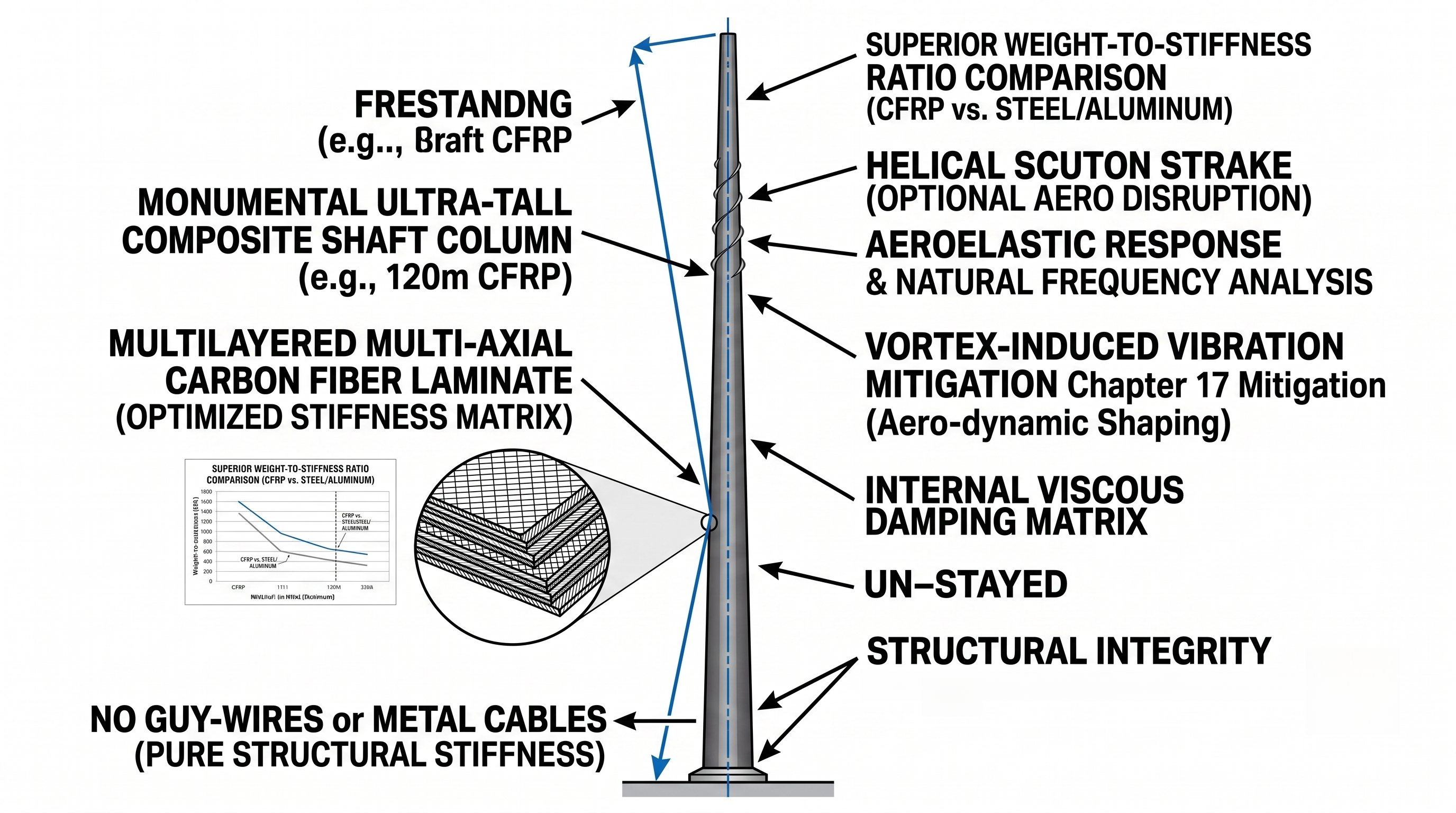
Where CFRP Can Help
Carbon fiber reinforced polymer, or CFRP, is attractive because it can provide high stiffness and strength relative to its weight. For a tall cantilever such as a flagpole, lower self-weight may reduce some foundation and handling demands. It can also support unusual architectural forms that are difficult to produce economically with conventional metal sections.
That advantage is conditional. CFRP is anisotropic, which means its properties depend strongly on fiber direction. A pole with fibers arranged mainly along the shaft can behave very differently from a pole with more hoop or bias plies. The laminate schedule has to match bending, torsion, local bearing, connection loads and handling loads.
Why CFRP Is Not Always Better
Aluminum and steel remain practical choices for many commercial flagpoles because they are familiar, inspectable, widely coded and cost-effective. CFRP can add complexity in manufacturing control, repair, fire review, lightning protection and long-term inspection. A project should compare materials using full lifecycle criteria rather than only a weight number.
For standard heights and ordinary sites, a well-designed aluminum or steel pole may be the simpler answer. CFRP becomes more relevant when the project needs a special combination of height, weight, corrosion resistance, geometry or transport constraints that conventional materials cannot meet comfortably.
Weight-to-Stiffness Design
The key structural question is not just "how strong is the carbon fiber?" The better question is "where is stiffness needed, and in which direction?" A flagpole sees bending from wind and flag loads, compression from self-weight, torsion from asymmetric attachments and local stress near access openings or base interfaces.
A useful CFRP laminate may combine longitudinal plies for bending stiffness, hoop plies for shell stability and off-axis plies for torsion and damage tolerance. The exact layup should come from project-specific analysis, manufacturing limits and quality control testing.
Dynamic Response and Vibration
Tall lightweight poles can be sensitive to dynamic behavior. Wind does not only push a flagpole sideways as a static force. It can also create repeated cross-wind loading, vortex-induced vibration and serviceability issues at the pole tip. A lighter shaft may reduce gravity load, but it can also shift natural frequencies and damping behavior.
For special CFRP flagpoles, the engineer should check natural frequency, damping assumptions, vortex shedding, fatigue-sensitive details and acceptable deflection limits. If needed, the design may use geometric shaping, tuned mass or liquid damping, internal damping treatments, or other project-approved vibration controls.
Base Connection and Load Transfer
The base connection often controls whether a composite flagpole detail is practical. CFRP does not behave like welded steel or aluminum. Loads must be transferred from the composite shell into a base sleeve, flange, anchor system or another engineered connection without crushing the laminate, peeling the bond line or concentrating stress at a hard edge.
A robust base detail may need bonded sleeves, mechanical fasteners, bearing inserts, tapered transitions, local thickening and corrosion isolation between dissimilar materials. The design should show how bending moment, shear, compression and uplift move from the shaft into the foundation.
Durability and Exposure
Outdoor CFRP systems need protection against UV exposure, moisture ingress, impact damage, temperature cycling and surface wear. The resin matrix and coating system are as important as the carbon fiber. A damaged coating can allow moisture and sunlight to reach the composite surface, making inspection and maintenance part of the specification.
Lightning protection also needs early coordination. Carbon fiber is electrically conductive, but a CFRP pole is not a conventional metal mast. Bonding, grounding, strike attachment, internal equipment and nearby structures should be reviewed by qualified electrical and lightning-protection specialists.
CFRP Design Review Matrix
| Design area | What to check | Why it matters |
|---|---|---|
| Laminate layup | Fiber angles, ply sequence, resin system and wall thickness | Controls bending stiffness, torsion, local buckling and damage tolerance |
| Dynamic response | Natural frequency, damping, vortex shedding and deflection limits | Tall lightweight poles can be governed by vibration or serviceability |
| Base interface | Sleeve length, adhesive, fasteners, bearing inserts and stress transition | Transfers overturning and shear without damaging the composite shell |
| Durability | UV protection, moisture control, impact resistance and repair method | Protects the resin matrix and keeps inspection practical over time |
Procurement Questions
- What problem is CFRP solving compared with aluminum or steel?
- Which laminate schedule, resin system and manufacturing process are proposed?
- How are wind load, flag load, vibration and serviceability checked?
- How does the base connection transfer bending moment and shear?
- What coating or surface protection is used for UV and moisture exposure?
- How is lightning protection coordinated with the composite shaft?
- What inspection and repair procedure is available after impact or storm events?
Frequently Asked Questions
When does CFRP make sense for a flagpole?
CFRP may be useful when a project needs high stiffness with lower self-weight, corrosion resistance or a special architectural form. It still requires project-specific structural, connection, fire, UV and maintenance review.
Is CFRP always better than aluminum or steel?
No. CFRP can offer high specific stiffness, but aluminum or steel may be more economical, easier to inspect and better matched to many standard flagpole projects. The best material depends on loads, height, exposure, code path and lifecycle cost.
What is the critical design issue for a CFRP flagpole?
The critical issues are usually the laminate schedule, local buckling, dynamic response, connection to the base, UV protection, lightning strategy and inspection method. These should be reviewed together rather than as separate details.
This guide is for specification and procurement planning. Final CFRP flagpole details should be reviewed by qualified structural, composite-material and electrical specialists for the project location.
References