


Commercial Flagpole Specification for Airports: Engineering Guide
Commercial Flagpole Specification for Airports: Engineering Guide
Airport flagpoles should be specified as part of the site, structural, operational and maintenance requirements. A one-piece shaft may reduce field assembly and visible joints where transport and lifting conditions allow, but it does not automatically solve wind, jet blast, radar, corrosion or regulatory issues.
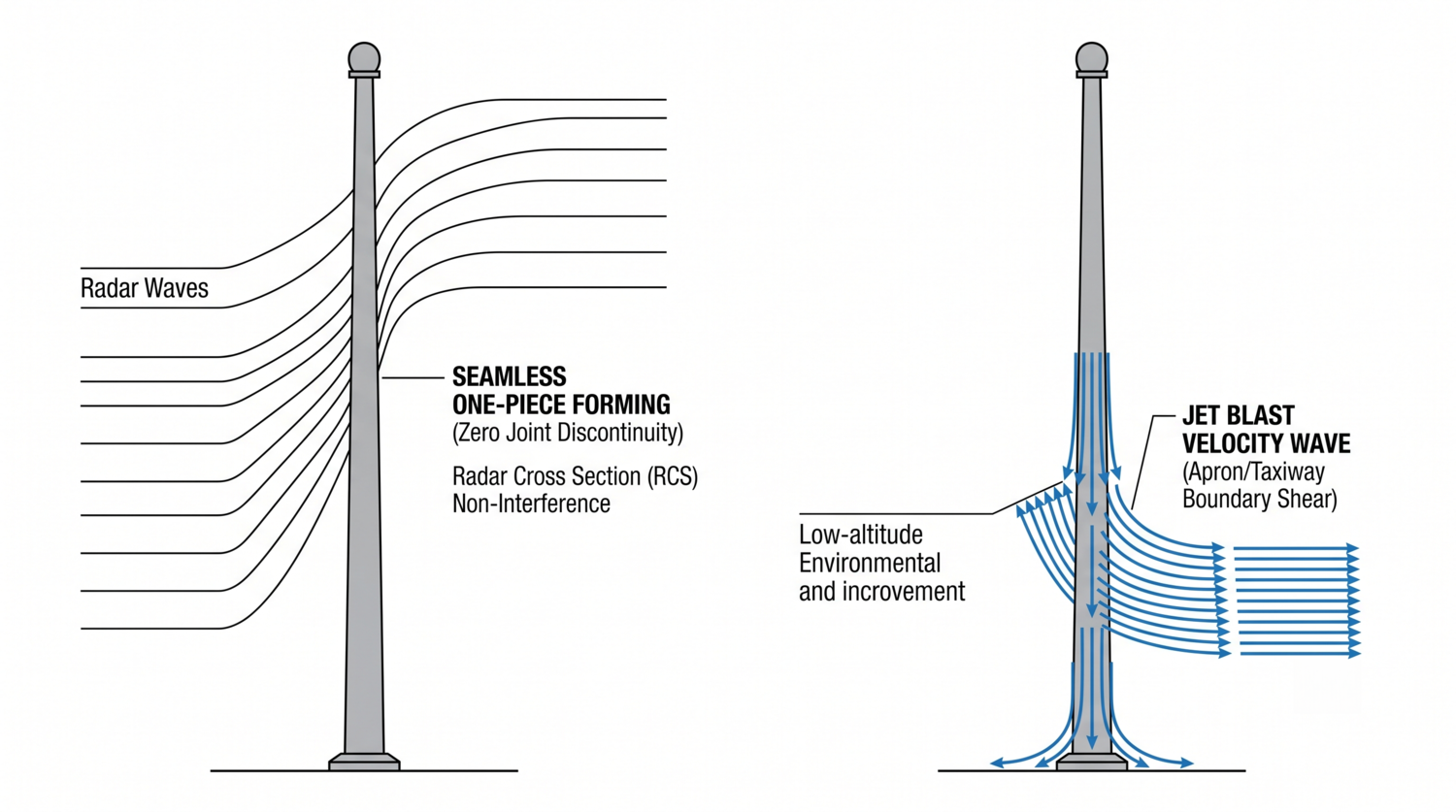
Airport flagpole specification reference for procurement and engineering review.
1. Start With the Airport Site Conditions
The same flagpole design may not be suitable for a terminal entrance, landside plaza, service road, apron boundary or restricted airside area. The project team should record the installation coordinates, ground conditions, design wind criteria, flag dimensions, expected operating hours and maintenance access.
Where the pole is close to aircraft movement areas, the owner should also identify possible exposure to jet blast, vehicle impact, foreign object debris controls, lighting systems and communication equipment. These conditions should be reviewed by the airport operator and the project engineer before the product is included in contract documents.
2. Radar and Electromagnetic Considerations
A smooth pole profile and limited external hardware can help reduce exposed fittings and simplify cleaning. However, a commercial flagpole cannot be described as radar-neutral or automatically non-interfering without a site-specific assessment.
If the installation is close to surface movement radar, navigation equipment, communications antennas or other sensitive systems, the airport authority should define the required separation distances and technical review process. The supplier may then provide dimensional drawings, material information, surface-finish data and any requested electromagnetic assessment documents.
3. Wind, Jet Blast and Structural Fatigue
Flagpoles are affected by the pole height, flag area, flag arrangement, exposure category, local wind speed, gust effects and foundation conditions. Jet blast is a separate operational loading issue and should not simply be replaced with a standard natural-wind assumption.
Ask the supplier and structural engineer to clarify:
- Design wind speed, exposure category and code basis.
- Flag size, number of flags and operating position.
- Aluminum or stainless steel alloy, wall thickness and section geometry.
- Connection details, base plate, anchor bolts and foundation reactions.
- Any special review required for jet blast or vehicle movement zones.
4. One-Piece and Sectional Flagpole Options
A one-piece or single-section pole can reduce field assembly and may provide a visually continuous shaft. It also requires suitable transport length, lifting equipment, route clearance and site access. For large airport projects, the lifting plan and delivery route may be as important as the product drawing.
Sectional poles may be more practical where road transport, crane capacity or installation access limits the maximum shaft length. The comparison should therefore consider total installed cost, installation time, joint design, inspection access, replacement planning and future maintenance rather than selecting a configuration only by appearance.
5. Materials, Finishes and Documentation
Airport procurement teams should request a document package that can be reviewed by the project engineer. Depending on the specification, this may include:
- General arrangement drawings and foundation interface details.
- Structural calculations or design data for the approved project criteria.
- Material certificates and alloy or grade information.
- Welding procedures, inspection records and repair procedures where applicable.
- Finish system, coating data and corrosion-resistance information.
- Halyard, winch, pulley, access and maintenance instructions.
- Packing, lifting, delivery and installation recommendations.
NAAMM FP 1001 can be used as a reference for metal flagpole loading and design considerations. AWS D1.2 may be relevant where aluminum structural welding requirements are specified. The project engineer must confirm the applicable edition, scope and contract requirements.
6. Airport Procurement Review Matrix
| Project condition | Main question | Documents to request |
|---|---|---|
| Terminal or landside plaza | Can the design integrate with architecture and provide safe maintenance access? | Drawings, finish data, foundation interface and maintenance plan |
| Apron or taxiway vicinity | Has the project team reviewed jet blast, vehicle movement and debris controls? | Site review notes, structural calculations and operational restrictions |
| Radar or communication-sensitive area | What authority review and separation requirements apply? | Location plan, material data, fitting details and requested technical assessment |
Frequently Asked Questions
Is a one-piece flagpole always better for an airport?
No. It may reduce field joints and assembly work, but transport, crane access, foundation design, wind loading and local approval requirements still control the final selection.
Can a smooth flagpole be described as radar-safe?
Not without a project-specific assessment. A smooth profile may reduce external fittings, but the airport authority must determine whether an electromagnetic review is required.
What should be included in a supplier quotation?
Request the product drawings, design criteria, materials, finish, flag and halyard equipment, foundation interface, inspection documents, delivery scope and installation assumptions.
Which standards should be referenced?
The project engineer should confirm the applicable local building code, airport authority rules, NAAMM flagpole guidance, welding requirements and any FAA, EASA or national aviation requirements that apply to the site.
References